Written by Victoria Gresham | March 4, 2022
In the vast plains and moraines of what is known as Porter County, the land was traveled by French fur traders and Catholic missionaries seeking new conquests for France. Between 1679-1711, Robert Cavilier, Sieur de la Salle left Canada to explore the Mississippi River. In April, 1682, La Salle reached the mouth of the Mississippi, staking claim of the traveled lands in honor of the French King Louis XIV, to which the lands of Porter County became a dependency of France.
Porter County still had a long way to go before gaining independence and establishing its government. It would take over 150 years before it would be recognized as a county, while it waited for its Northwest Territory lands to become a state. The Indiana Territory northwest of the Ohio River was organized on May 7, 1800. Indiana was then admitted to the Union on December 11, 1816, becoming the 19th state. But Porter County’s destiny would still be out on the horizon.
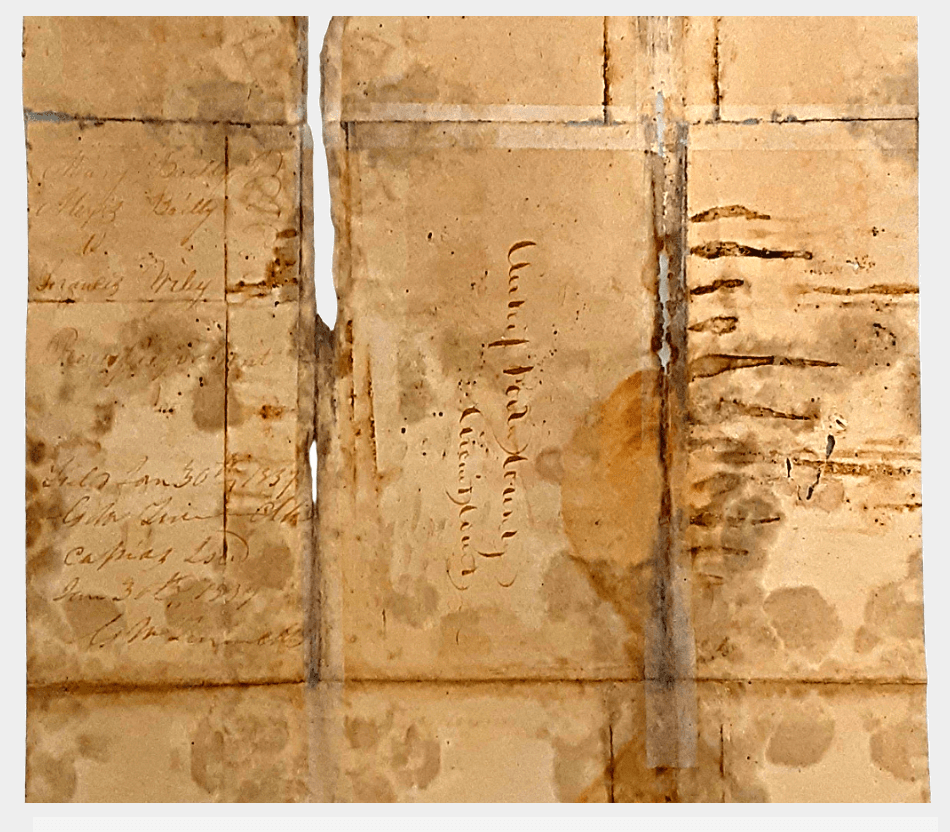
Source: Porter County Clerk’s Archives, Porter County, IN; Photo Credit: Victoria Gresham (September 30, 2021)
While Indiana became inhabited by its early settlers, Porter County was predominantly occupied by native Indians. It would take 6 more years since Indiana’s statehood before a white man would settle there. Joseph Bailly, a 48-year-old French-Canadian fur trader was the first known Euro-American settler of Porter County in 1822 occupying a cabin on the north bank of the Calumet River, in the area known today as Westchester Township. On January 30, 1837, Joseph Bailly would become one of our county’s first settlers to have his personal matters filed in court with the county clerk’s office by his family members after his death.
Joseph Bailly would not live long enough to see the transformation of his settlement become an integral part of a new county. Only 2 months shy of its creation, Mr. Bailly was buried and laid to rest in a little cemetery on the Bailly Homestead in December of 1835.
On January 28, 1836, the Indiana State Legislature passed an act creating present day Porter County, effective February 1, 1836. The Bailly family document was filed in relation to Joseph Bailly’s estate and is transcribed as follows:
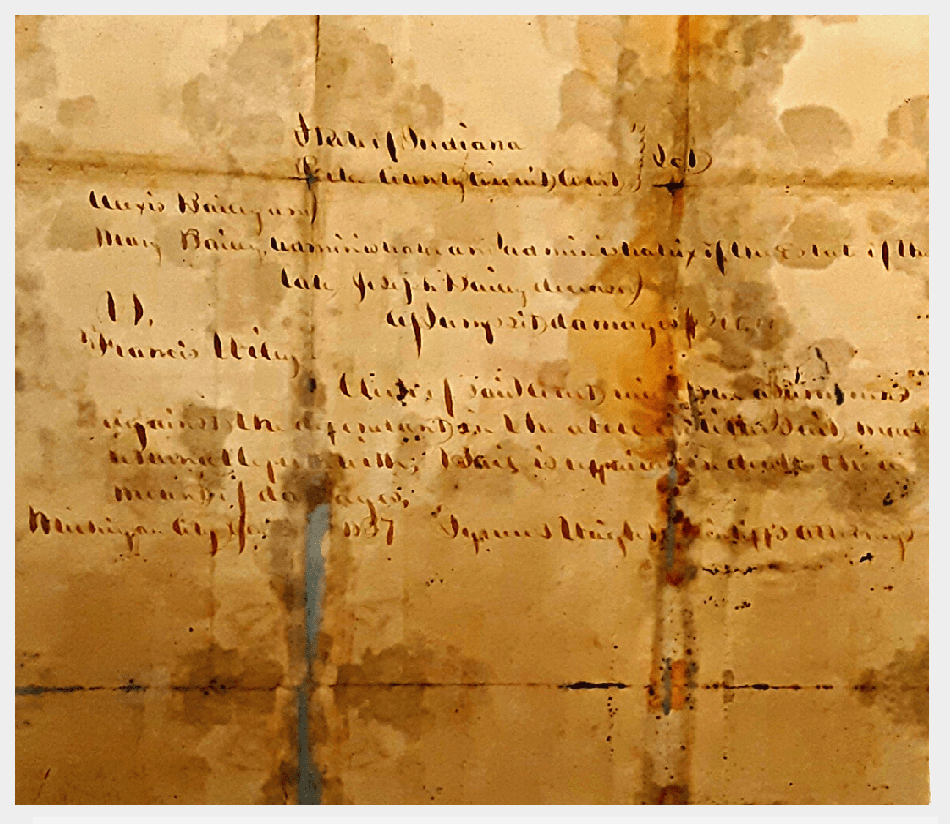
Source: Porter County Clerk’s Archives, Porter County, IN; Photo Credit: Victoria Gresham (September 30, 2021)
Transcription of front side of document:
Clerk of Porter County Circuit Court
Mary Bailly Alexis Bailly
Vs
Francis Wiley
Precipe for Writ
Filed on January 30, 1837
G W Turner Clerk
State of Indiana
Porter County Circuit Court
Transcription of back side of document:
Alexis Bailly and
Mary Bailly, administrator and administratix of the Estate of the late Joseph Bailly deceased
of [illegible] damages is $300.00
Vs
Francis Wiley
Clerk of said court will {issue a judgment?} upon ____ against the defendant in the above matter said ____ ____ with; ____ is ___the amount of damages,
Michigan City ____ 1837
[Illegible] Wright Plaintiff’s Attorney
During March of 1835, Porter County remained under the jurisdiction of La Porte County, which itself had only been a county since April 1, 1832. Indiana legislation approved the act to form La Porte County on January 9, 1832. Newly elected officials were selected, including the new Clerk, George Thomas. During this period, the new Circuit Court commenced its jurisdiction with those residing on the bench known as Gustavus A. Evarts, Samuel C. Sample, John B. Niles, Ebenezer M. Chamberlain, and Robert Lowry.
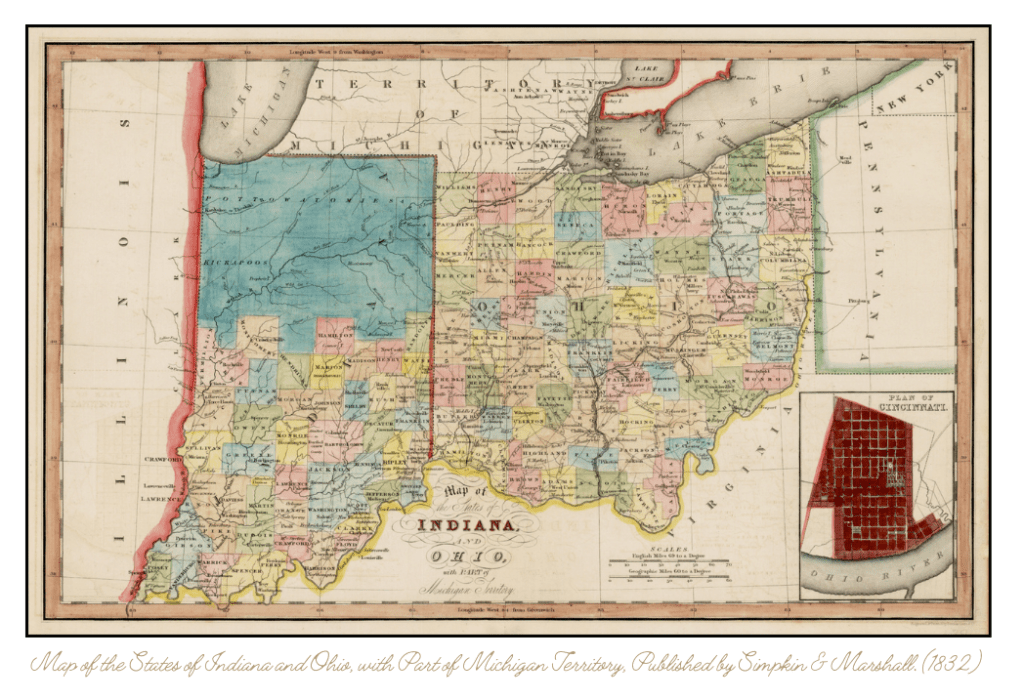
The La Porte County commissioners held authority over all the territory west of its county extending from the Kankakee River to Lake Michigan and west to the western boundary of the state, including the present counties of Porter and Lake. All matters of the court were previously filed with the La Porte County Circuit Court Clerk until such division occurred and legislation passed that would affect Porter County as we know it today. Through their official powers, the commissioners issued an order for the division of the region into three townships, to wit:
“The township of Waverly to be bounded on the north by Lake Michigan, east by the Laporte county line, south by the line between Townships 35 and 36 north, and west by the line through the center of Range 6 west. The township of Morgan to be bounded on the north by the south line of Waverly township, east by the Laporte county line, south by the Kankakee River, and west by the line through the center of Range 6 west. The township of Ross to include all the attached territory west of the line through the center of Range 6 west.”
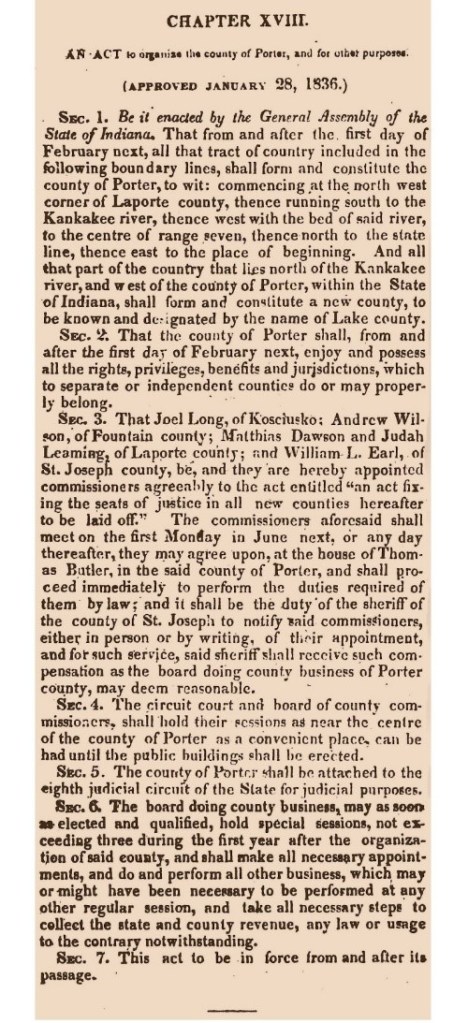
An Act to organize Porter County was approved on January 28, 1836. After February 1, 1836, through this act of legislation, an identified tract of land was set to be known as Porter County. The boundaries of Porter County would be marked as follows: “Commencing at the northwest corner of La Porte County, thence running south to the Kankakee River, thence west with the bed of said river to the center of range 7, thence north to the State line, thence east to the place of beginning.” The county would bear the name of Captain David Porter, naval officer war hero during the Barbary Wars and the War of 1812.
The first official business by the new Porter County governing officers was held at the first meeting of the County Commissioners on April 12, 1836, to which they appointedGeorge W. Turner as the first Clerk of the Circuit Court. In June, 1836, the commissioners, who were appointed by the state legislature, selected a tract of land named Pottersville as the new county seat. Though no dwellings existed on the land, it would become appealing to new settlers. Pottersville was situated in the center of the county at the “southwest quarter of section 24, township 35 north, range 6 west,” and owned by Benjamin McCarty, a LaPorte County probate judge and member of the Portersville Land Company. By the end of 1836, eight houses existed, including the house of John Saylor, where the first Porter County court was held in October, 1836 and presided by Judge Samuel C. Sample.
Source: Indiana General Assembly’s Laws of a General Nature, 1836.
THE FIRST COURT SESSION
Since a courthouse didn’t exist for the new county, the first court hearing was held at the Saylor homestead. Although the home could accommodate a court session, it did not have the amenities of a jury room. Instead, jurors would meet to deliberate under a large oak tree near the home to conduct their “secret sessions.” It was apparent the county needed a court house. However, the county treasury was in no financial position to erect one.
Porter county residents took matters into their own hands, and in early 1837 launched what may have been the county’s first privately organized citizen’s fundraiser. The goal was to raise funds that would allow the construction of a court house and jail. Citizens circulated a subscription paper and soon raised $1,250 for the erection of the two buildings. In the same year, a 20 by 48 feet frame court house was built near the present-day court house and in 1838, a log jail was built near the public square.
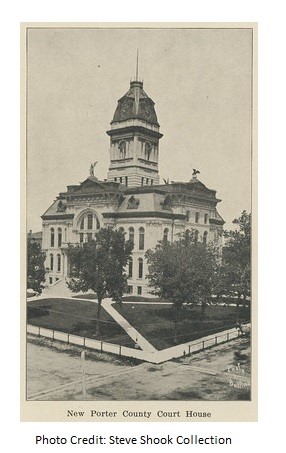
The framed court house would serve its purpose for the next sixteen years until 1853, when a new court house would take its place. The county faced several delays and obstacles during its construction but in the end, it would become “the handsomest county buildings in the state.”
CLERKS IN PORTER COUNTY
George W. Turner was elected as the first clerk in Porter County on February 23, 1836. Five homes were designated as polling sites for the elections, comparable to today’s standards that could be considered as central vote centers. 180 votes in total were cast to elect the first county officers, including the Clerk. The homesteads of William Gossett (26 votes), Isaac Morgan (55 votes), Morris Wilson (24 votes), John Spurlock (35 votes), and J. G. Jackson (40 votes) became the sites of the first electoral process. William Gossett’s home was the first frame house in Salt Creek in the western part of Liberty Township.
Since Joseph Bailly, the first pioneer, settled the county, Porter County has grown into a flourishing county with a current population of 173,215 according to the 2020 United States Census Bureau making it the 10th most populated county in the State of Indiana. Thousands of court records have been maintained by the clerk’s office since its formation. In December, 1934 the courthouse was destroyed by fire; but all the records were saved. Many individuals have held the clerk position since 1836, including probate clerks, whose role followed the county clerk and oversaw the court docket concerning wills and estates. While George W. Turner sat at the helm as the first County Clerk for nearly a decade, he paved the way for others to follow. A few of those identified by Porter County court records include:
John C. Ball, (1845 Will)
O. Dunham (1856 Will)
E.J. Jones, (1860 Complaint)
S.W. Smith (1869 Marriage License)
Rufus P. Wells, (1871 Common Pleas);
J.R. Drapier (1883 Complaint)
E.C. O’Neill (1892 Estate)
E.L. Wilson (1895 Estate)
ROLE OF THE CLERK
According to the Indiana Constitution, the General Assembly was tasked with dividing the state into judicial circuits. Porter County constitutes the sixty-seventh judicial circuit. The Clerk of the Court is an officer of the court responsible for maintaining records of the court on the federal, state and local levels. Clerks are an important role and serve at the highest level from the Supreme Court of the United States to the local circuit courts.
The Clerk of the Circuit Court works with the judicial officers to oversee the court’s administration of cases within the court system. The Clerk is responsible for the record keeping of case files, collection of court fees, sheriff service fees, child support, civil judgments, criminal fees, restitutions and beyond as defined by state laws. During the nation’s formative years, the clerks were appointed by the judges to carry out administrative duties. Since then, clerks have evolved into an integral part of the court system.
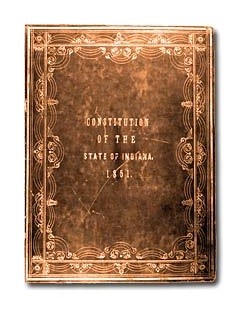
The role of the Clerk is quite different from a judge’s law clerk, who assists a judge with research or drafting opinions. The Clerk of the Circuit Courts is an elected official, an officer of the courts, and the custodian of court records and seal. The Clerk’s responsibilities are defined by Indiana statute and the Indiana Constitution effective November 1, 1851, which is the state’s second constitution superseding Indiana’s 1816 initial constitution adopted.
IC 33-32-1-1 “Clerk” defined: Sec. 1. As used in this article, “clerk” means a clerk of the circuit court elected and qualified under Article 6, Sections 2 and 4 of the Constitution of the State of Indiana. [Pre-2004 Recodification Citation: 33-17-1-1.] As added by P.L.98-2004, SEC.11.
THE FIRST CLERK OF THE SUPREME COURT
How did Porter County, Indiana and other growing U.S. territories have the ability to fill a clerk’s position so long ago? It happened nearly 233 years ago with the founding of our nation.
After the Revolutionary War, a fierce commander and man of strong moral character named George Washington, a retired military United States General, was sworn in as the First President of the United States of America on April 30, 1789 in New York City, New York. The results came days after 69 early American state representatives casted their vote on February 4, 1789 for the first presidential election. He won by unanimous vote becoming the first and last presidential candidate to achieve such honor. Washington didn’t campaign for the presidency, but his reputation as a national hero of the American Revolution preceded him amongst the citizens of the new found country and paved his way to the White House.
Within months of taking office, President George Washington signed into law the Judiciary Act of 1789 on September 24th, which became one of the first acts of the First Congress of the newly formed nation. Although the act established the United States’ federal court system, the individual state courts remained separate in their oversight of their courts. He then appointed his first cabinet and justices. On February 3, 1790, Jonathan Tucker was the first clerk appointed to the Supreme Court two days after the court held its first session. Congress had authorized the position whose purpose was to “enter and record all the orders, decrees, judgments and proceedings of the said court.”
The JUDICIARY ACT OF 1789
Officially titled “An Act to Establish the Judicial Courts of the United States,” Article III of the Constitution established a Supreme Court, but the authority to create lower federal courts was left to Congress to enact.
- Congress could regulate the jurisdiction of all federal courts.
- The federal district courts and circuit courts would have specific, limited jurisdiction.
- The Supreme Court would have the original jurisdiction provided for in the Constitution.
- The Supreme Court would handle appeals from the federal circuit courts and appeals from certain cases heard in the state courts.
(References: The Lewis Publishing Company. 1912. History of Porter County, Indiana: A Narrative Account of its Historical Progress, its People and its Principal Interests. Volume I. Chicago, Illinois: The Lewis Publishing Company. 357 p.; Shults-Gay, Deborah H. 1923. One of the Earliest Authentic Histories of Porter County, Indiana, From 1832-1876; Ball, Timothy H. 1900. Northwestern Indiana from 1800 to 1900 or A View of Our Region Through the Nineteenth Century. Chicago, Illinois: Donohue and Henneberry. 570 p.; Guide to 2010 State and Local Census Geography – Indiana – History. Census.gov.; 2020 Census Bureau Quick Facts: Porter County, Indiana. http://www.census.gov.; The Lewis Publishing Company. 1912. History of Porter County, Indiana: A Narrative Account of its Historical Progress, its People and its Principal Interests. Volume I. Chicago, Illinois: The Lewis Publishing Company. 357 p.; Lake Calumet Region of Indiana, Vol. 1; “Who Does What, Clerk of Court and Clerk’s Office Staff,” Federal Judicial Center. United States Federal Judicial Center; “Order in the Courts: A History of the Federal Court Clerk’s Office by I. Scott Messinger; “Anniversary of the Federal Court System.” United States Courts. uscourts.gov; The White House. whitehouse.gov; “The Presidents of the United States of America,” by Frank Freidel and Hugh Sidey; “How George Washington’s Personal and Physical Characteristics Helped Him Win the Presidency,” by Tim Ott, February 7, 2020, Biography.com; Library of Congress: Primary Documents in American History.)
 The Dash