Written by Victoria Gresham | September 2, 2022
One of the most successful lawyers in history was Marcus Tullius Cicero. He was a Roman statesman, war hero, scholar, orator and philosopher, who lived between 106 BC-43 BC. He made a career of the law and introduced philosophy to Rome, which transcended into the modern world. His words of wisdom have resonated for centuries, including “Honesty is the best policy” and, “The good of the people is the greatest law.”
Image Source: Marcus Tullius Cicero, the author of the Consolatio
Wikipedia.org (2021)

His classic writings, such as, “Selected Works,” have been a valuable source to many. But there was one key actor during the Roman Empire that helped preserve Cicero’s words, a Roman slave by the name of Tiro. Marcus Tullius Tiro recorded Cicero’s speeches with a shorthand system he developed called “notae” in the days of antiquity. Plutarch, the ancient Roman mathematician and philosopher, regarded Tiro, and others similar, as Cicero‘s “clerks” because of their excellent rapid writing skills. Tiro’s shorthand of Cicero’s speeches was famously known as “Tironian notes,” since the combined signs became the writing art of recordkeeping. One Tironian symbol that modern clerks use today is the ampersand, “&” or better known as the “and” symbol.
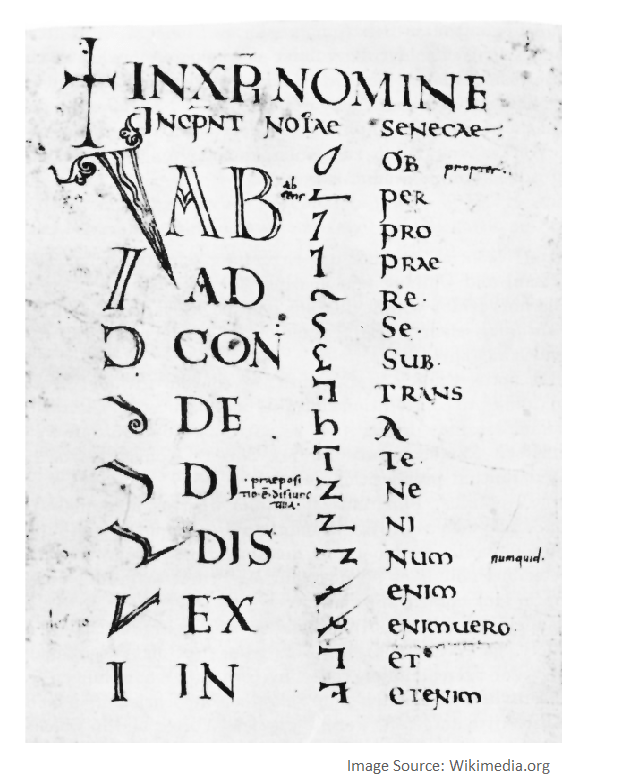
Although notaries can be traced to Ancient Egypt, where the earliest known Egyptian records and proclamations were integral to their bureaucracy, Tiro would find his place in history as the first true notary. The Tiro system included 4,000 signs, which increased to 13,000 signs by the Medieval period when it reached the monasteries. The system would preserve the early recordings of Cato the Younger’s speech of the infamous conspiracy attempt to overthrow the Roman Republic only by Cicero’s swift efforts in placing his clerks throughout the senate-house to capture Cato’s spoken words. The word “Notary” is derived from the Latin words Notae Tironinae or nota. Since literacy was not common in the ancient world, others capable of writing or skilled in stenography were known as “Notarius” and charged a fee to prepare wills, contracts and critical documents. The demand for notaries increased with the needs of the public and grew as literacy developed in Rome and over the ages. According to Brooke’s Notary (13th Edition) by Nigel P. Ready, the notary held great responsibility towards authenticating records.
NOTARY PUBLICS IN AMERICA
Over the 2,000 years that Notary Publics existed, Early America in the colonial period of 1600 AD-1800 AD unfortunately would experience the threats and dangers of the unique profession. The integrity of a notary was vital during the transactions of trans-Atlantic commerce. Notary publics were held in the highest regard, having been entrusted with their client’s official documents. Cicero’s principle of honesty held steadfast in early America as notaries were responsible for tracking valuable cargo that came from abroad after a ship’s voyage to the New World. Notaries were tasked with verifying bills of exchange, damage control and recording lost revenue amidst the controversy over control of the New World. Since an international banking system did not exist, notaries were critical to maritime trade and their notarial acts were known as “marine protests.” Many lost their lives due to their involvement in authenticating such official documents. Being a notary in Early America was an honorable duty, whose role would evolve with the most important matters of the colonists. Only one notary on record in 1686, by the name of Adriaen Janse van Ilpendam, a Dutchman living in Albany, New York, died from suicide at the age of 68 years old.
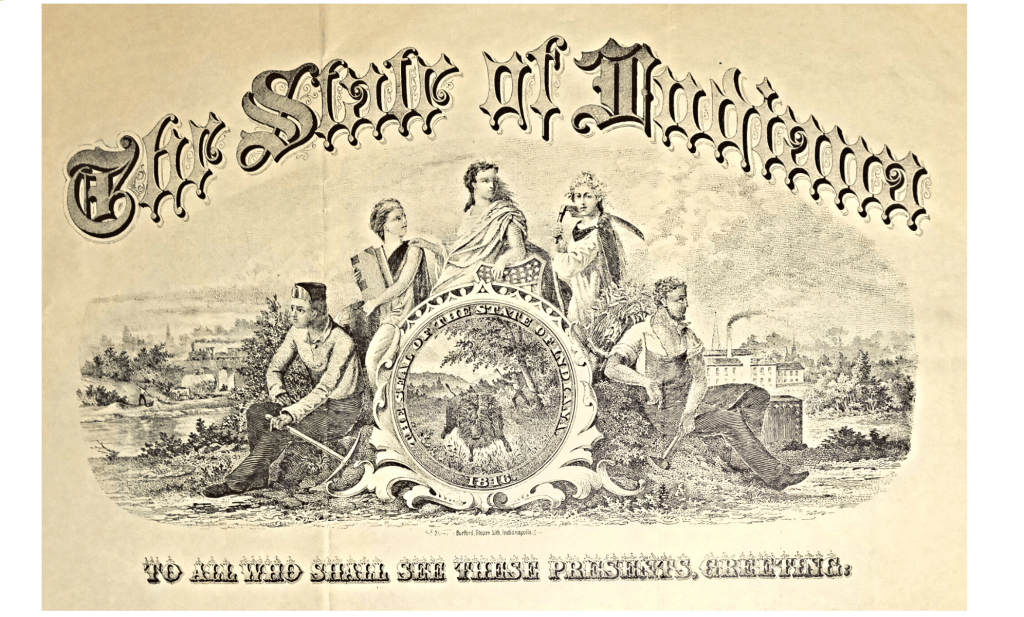
Source: Porter County Clerk’s Archives, Porter County, IN; Photo Credit: Victoria Gresham (January 5, 2022) Notary Commission of Thomas J. Clevenger, February 9, 1895 Signed by Claude Matthews, 23rd Indiana Governor
Meanwhile, in the Midwestern states, notaries were becoming more relevant after the Civil War ended in 1865. Notaries were important to the early governing bodies as pioneers settled the lands. Their duties included verifying signatures on documents and administering oaths of office, plus other matters of public affairs. Notaries must be law abiding, honest, impartial citizens of the state. They are required to take an oath to obey the laws of the United States and the State of Indiana. Notaries are considered public officials and must be bonded to protect their notarial acts from liability in errors. Current laws governing notary publics are defined within Indiana Code, Title 33 Article 42.
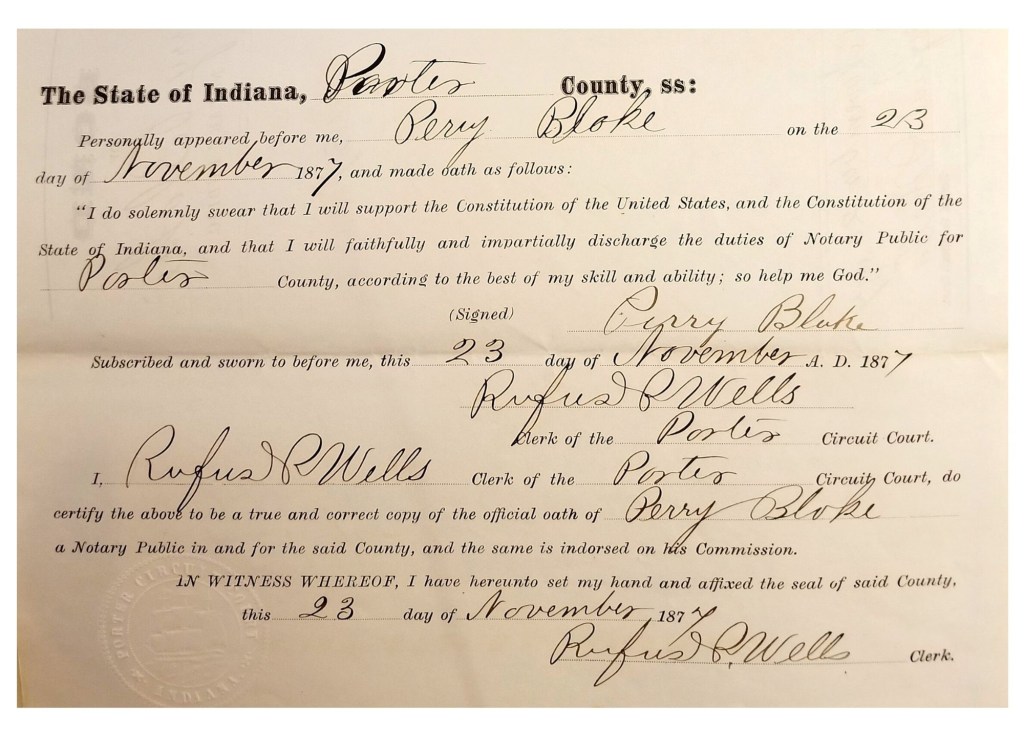
Some of the earliest Porter County notary publics identified since the state formed in 1816 during and after the Civil War personally appeared before the County Clerk to pledge their oath.
“I do solemnly swear that I will support the Constitution of the United States, and the Constitution of the State of Indiana, and that I will faithfully and impartially discharge the duties of Notary Public for Porter County, according to the best of my skill and ability; so help me God.”
(Signed) Perry Blake, November 23, 1877
Source: Porter County Clerk’s Archives, Porter County, Indiana. Photo Credit: Victoria Gresham (January 5, 2022)
Porter County Notaries
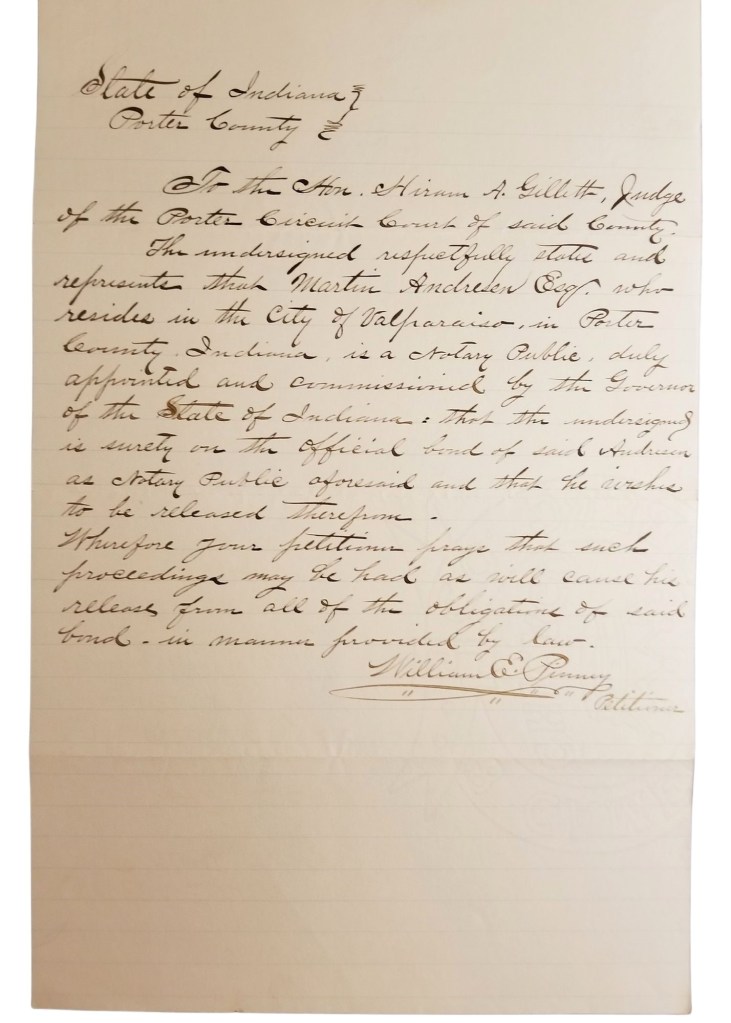
Throughout the years since Indiana became a state in 1816, many have served as notary publics. Notaries were required to secure a bond for amounts up to $1,000 and on occasion would petition the court to be released of that obligation. For example, William E. Pinney filed a petition on behalf of Martin Andresen Esq. and notary seeking release of his bond on March 25, 1876.
Source: Porter County Clerk’s Archives, Porter County, Indiana Photo Credit: Victoria Gresham (January 5, 2022)
“Petition for Release as Surety on Official Bond”
Filed on March 25, 1876
Past Notary Publics
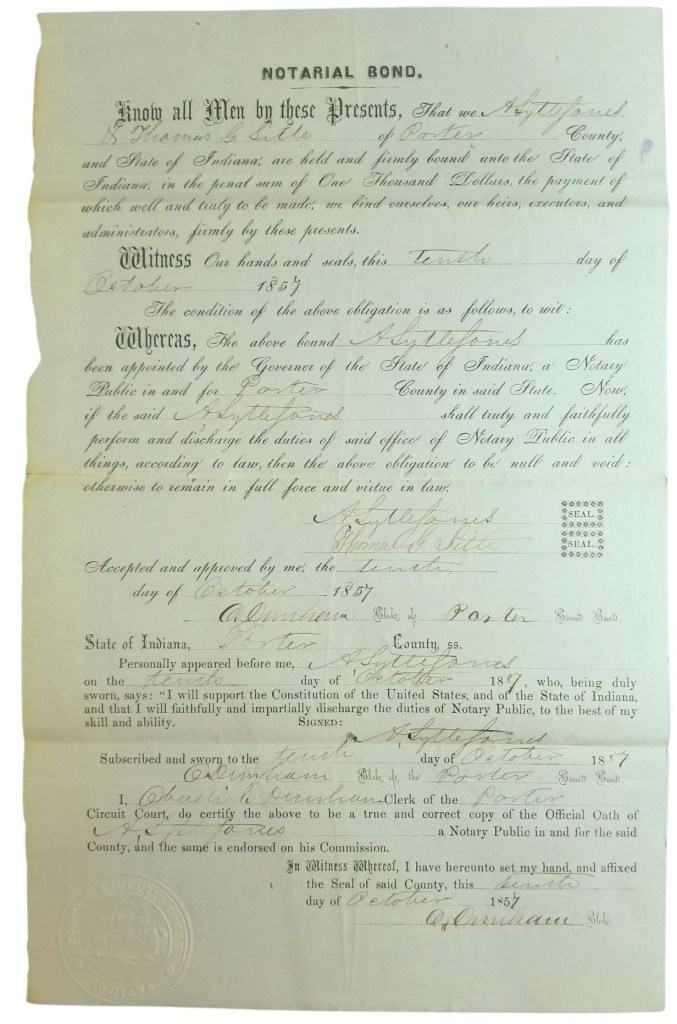
One of the earliest notaries in Porter County on record was A. (Aaron) Lytle Jones, who became an integral part of the Porter County legal system. When Porter County was originally formed in 1836, there were no lawyers in the county when court held its first hearing in the home of James Spurlock with Judge Samuel C. Sample of South Bend presiding. Eighteen men were summoned to the Circuit Court as grand jurors, including 24 petite jurors, many who were Porter County’s first settlers such as John Spurlock, first homeowner in Valparaiso and Reason Bell, who was one of the county’s first commissioners.
Aaron Lytle Jones was born in Wayne County, Ohio and in 1847 settled in Horse Prairie, Boone Township. He was a Civil War veteran, who served in the 7th Indiana Cavalry and held ranks of Sargeant and Regimental Quartermaster. He earned a Bachelor of Arts degree from Indiana State University and graduated in 1855. Jones studied law as one of the first members of the Porter County bar association and for many years was the senior member of the Jones, DeMotte and Jones law firm, whose partner DeMotte was a Member of Congress from the Tenth District.
On October 10, 1857, Aaron Lytle Jones presented his notarial bond of
$1,000 to which he “shall truly and faithfully perform and discharge the
duties of said office of Notary Public…”
Notary Publics Serving Porter County Since 1836
Porter County held its notary publics with high regards since its formative years. Notaries were critical to the development of the county structure, its new court system and authenticating official documents. Those notaries include:
A. (Aaron) Lytle Jones – 1857
Jonathan C. Littlefield – 1858 Joseph M. Dorr – 1861
B. Lytle Jones – 1866
Charles N. Morton – 1871
Perry Blake – 1874
John Skelton – 1886
Thomas J. Clevenger – 1895
Early American Women Notaries
Men were the majority of notaries since the beginning of its profession. Women were not commissioned until 1866 when Emily Calkins Stebbins would become the first woman to hold the position one year after the Civil War would end. Of the 37 notaries commissioned in Porter County in 1896, only 2 of them were women. Some of the earliest known women notaries listed on the Porter County rolls of the 1896 biennial report issued by the Indiana Secretary State are Henrietta Carol of Valparaiso, commissioned on February 13th and four months later, Hannibal H. Loring of Valparaiso, was commissioned on June 19th. Most laws affecting women were determined by their marriage status. The women’s suffrage movement and the changing course of colonial America provided opportunities for women to serve as notary publics paving the way for other women to follow.
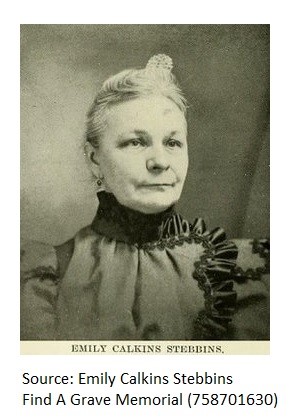
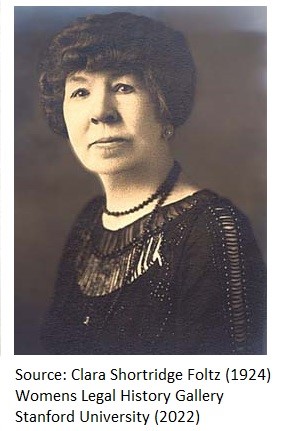
The first woman notary in the United States was Emily Calkins Stebbins, who was commissioned on February 2, 1866 by Iowa Governor William M. Stone. Clara Shortridge Foltz, born in Lafayette, Indiana in 1849, wed at 15 years old then moved to California with her husband. The daughter of a lawyer, Clara broke down barriers after becoming widowed in 1877. Being familiar with the practice of the law, Clara embarked to change the system.
Clara discovered that the California constitution limited admission to the bar to only “white males” so she led the efforts to change the law by authoring the “Woman Lawyer’s Bill.” Legislation passed in 1878, but she faced many obstacles afterwards that led her to the Supreme Court to argue her case against Hastings College of Law in San Francisco for denial of admission. She later triumphed and won her case. Clara was a trailblazer being one of the first original suffragists casting her vote in 1911. She led legislation that allowed women to serve as executors and administrators of estates and to hold commissions as notaries. She was the first woman notary commissioned in California and the first woman prosecutor to try a murder case. Later in life at 81 years of age, Clara ran for Governor of the State of California. Clara was a champion for women’s rights and changed the trajectory for women as notaries, lawyers, and voters across the nation.

United States and Indiana Notaries
Currently, there are over 4.4 million commissioned notaries across the United States. In Indiana, notaries were once required to submit a copy of their state commission to the county clerk for record keeping. However, according to Indiana Code 33-42-13-2, the Indiana Secretary of State maintains a database of active notary publics. Between 1894 AD–1896 AD and 1906 AD–1908 AD, the Indiana Secretary of State reported 37 to 40 active notaries for Porter County. Today, that number has multiplied to thousands across the State of Indiana. The $1,000 bond of yesteryear has increased to a $25,000 bond and notaries commissions last 8 years. Recent changes in Indiana law effective July 1, 2018 require notaries to take an educational course and pass an exam administered by the Indiana Secretary of State.
The President’s Notary
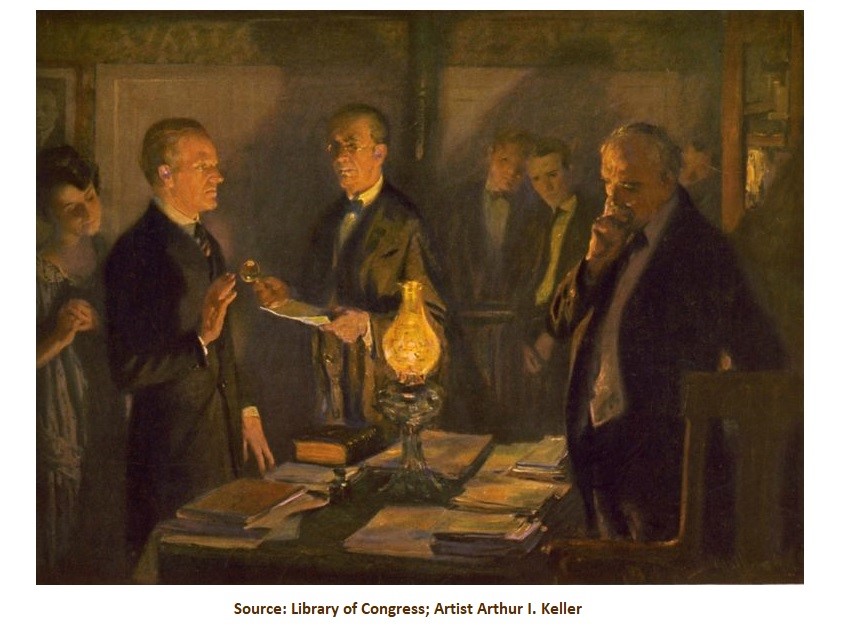
On August 3, 1923, Vice President Calvin Coolidge learned that the sudden death of President Warren G. Harding had transferred the powers of the presidency into his hands. While visiting Vermont, his father, Colonel John Calvin Coolidge Sr., who was a notary public, administered the presidential oath of office to his son in the early morning hours by light of a kerosene lamp. President Coolidge would become the only president to ever be sworn into office by a notary.
(References: Cicero: National Geographic Society; Cicero: Britannica; Marcus Tullius Cicero Quotes: brainyquote.com; History of Greece and Rome, Antiquitatem; A History of the Notary-Ancient Rome, Malaysia Notary Public; Notary History, National Notary Association; Death of a Notary: Conquest and Change in Colonial New York by Donna Merwick; Porter County Clerk’s Archives, Porter County, Indiana; Indiana Notary Public Guide, Office of the Indiana Secretary of State; Counties of Porter & Lake Indiana: Historical and Biographical, Chicago F.A. Battey & Co. Publishers 1882; The Vidette-Messenger, Valparaiso, Porter County, Indiana; August 18, 1936; Volume 10, Section 2, Page 12; Annual Reports of the Officers of State of the State of Indiana, Administrative Officers, Trustees and Superintendents of the Several Benevolent and Reformatory Institutions 1897 & 1908; Biennial Report of William D. Owen Secretary of State of the State of Indiana for the Two Years Ending October 31, 1896 to the Governor; Emily Calkins Stebbins: Globe Gazette (Mason City, Iowa) May 30, 1933, Newspapers.com; Emily Calkins Stebbins, Wikipedia; Clara Shortridge Foltz, American Lawyer and Reformer, Brittanica.com; Clara Shortridge-Foltz, Notary Public Seminars; Calvin Coolidge, The White House.)
 The Dash