Written by Victoria Gresham | April 28, 2023

Healing the Sick
Have you ever had an itchy throat or a constant cough that won’t stop? Catching that common cold often comes with battling symptoms of hoarseness and a sore throat. Being in the middle of a conversation to then whirl into an unexpected coughing fit doesn’t make for the most pleasant of circumstances. This is nothing new as people over the years have experimented with various remedies to soothe these annoying symptoms for decades.
The Remedy of All Time
In the 1800s, folks in Porter County were no different to those who sought the world far and wide for instant relief. Such evidence was found in an unusual place on a document that was discovered amongst the archived records. The 1891 advertisement of “Brown’s Bronchial Troches,” was a single sheet of paper with inscription on its back page pertaining to the death of Martin Peterson and the Coroner’s Inquest held on October 12, 1891. The troches known as an every day throat lozenge is undetermined if it had any significance or influence on his death.

It was during the time that H.C. Coates, M.D., Coroner of Porter County conducted his investigation on Mr. Peterson’s death that tied the two topics together. At the time, Coates needed to write down the names of the witnesses to Mr. Peterson’s death and opted to use an odd piece of paper to collect the names.
The blank back page of the advertisement served its purpose as Coates transcribed his notes. The county suffered a loss as Mr. Peterson’s family and friends learned about his horrific suicide.
Mr. Coates determined that Martin took his own life “by cutting his throat with a large pocket knife as a result of suicidal intent as a result of alcoholic excess as revealed by the evidence and post-mortem examination of his stomach.”
Image Source: Porter County Clerk Archives, Picture by Victoria Gresham March 9, 2023
No where is it mentioned in the coroner’s inquest whether or not Mr. Peterson had used the lozenges to soothe an existing ailment. It may have been a random act that Dr. Coates used the back page of the advertisement as scrap paper for his investigation. The unique advertisement shows the prominence of its healing powers and its popularity at that time.
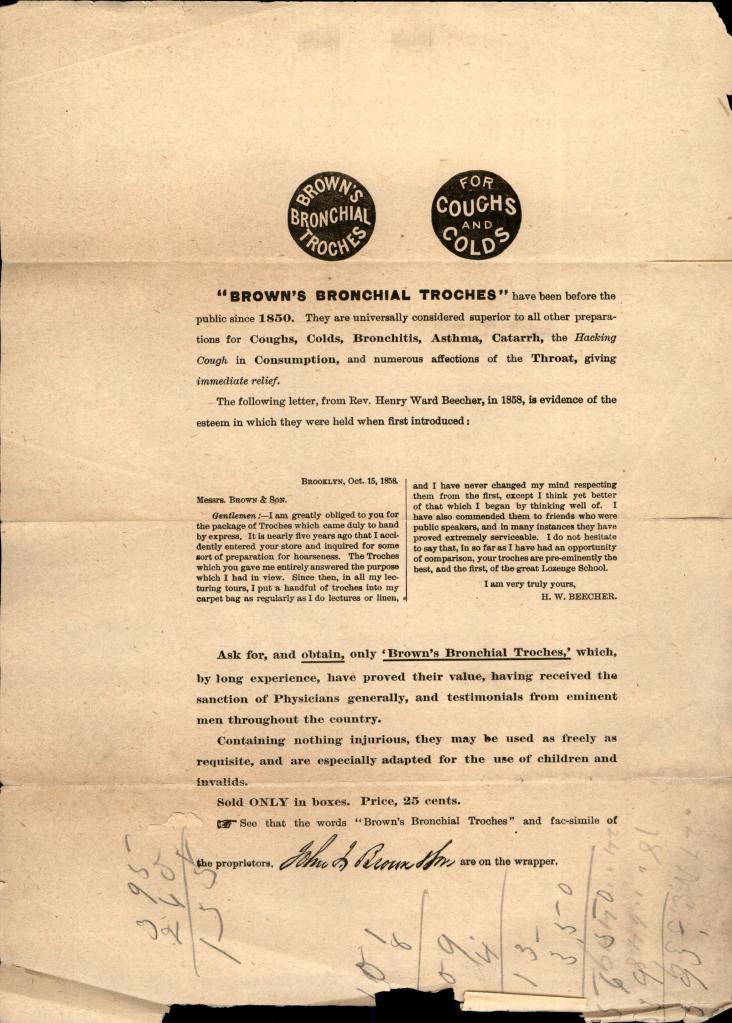
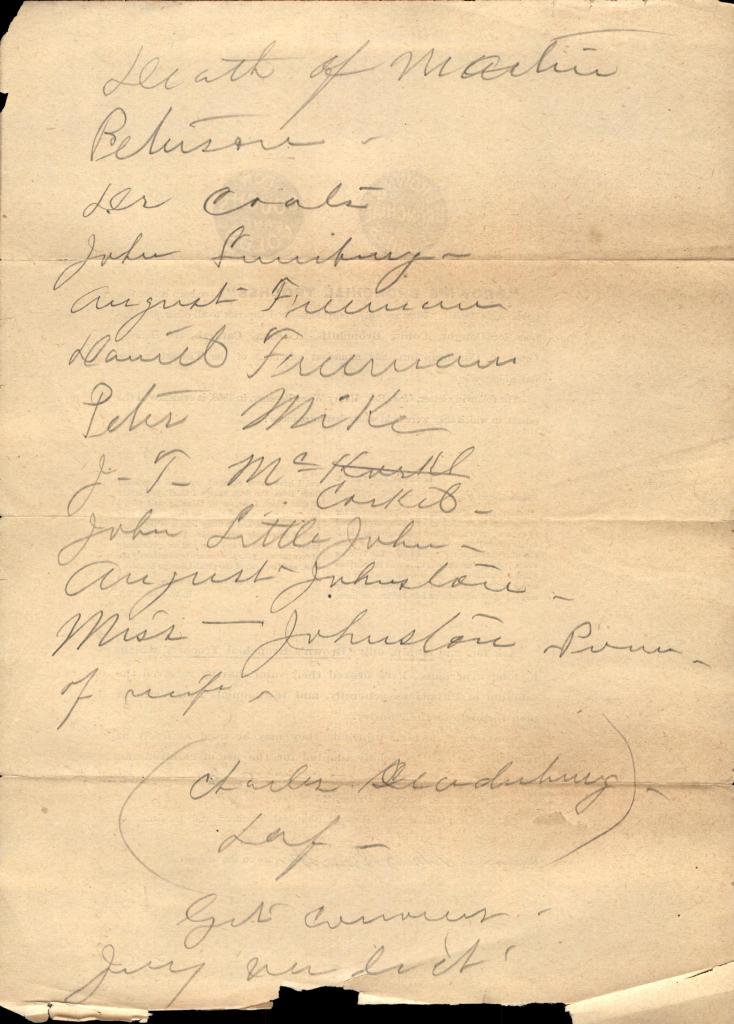
Image Source: Porter County Clerk Archives, Picture by Victoria Gresham March 9, 2023
The Origin of Brown’s Bronchial Troches
The inventor of these popular lozenges is attributed to John I. Brown, who left Little Compton, Connecticut in 1807 to reside in Boston. John, the eldest of four brothers, was accepted as an apprentice apothecary by Dr. Stephen Thayer, who owned a small drug store on Newbury Street. Brown bought the business in 1812 and remained in business for the next 58 years in the same location. The store was a small two story wooden building with an attic, which Brown slept in a small bedroom in the attic. The second floor was used as a rental apartment. Brown stayed in the attic until he purchased a home in Boston later in life. Brown’s Bronchial Troches, along with his product, Mrs. Winslow’s Soothing Syrup allowed him to retire financially and comfortably well-off. Brown’s sense of using advertisement to his advantage helped expand his business.

The cough lozenge was patented on August 12, 1862. Its claim to be a soothing remedy for coughs, colds, hoarseness and sore throats was widely upheld across the nation by all walks of life from the average citizen to state dignitaries. The popular lozenges were desired amongst the circles of singers, actors, and public speakers who endorsed Brown’s product and became part of his advertising strategy. During the Civil War, a New York druggist sold a copy-cat version of Brown’s product to Union soldiers. Brown took the New York druggist to court and won his case. The copy-cat druggist was sent to prison for his misdeed. Later, Brown began advertising his lozenges with the warning, “Guard Against Worthless Imitations.”
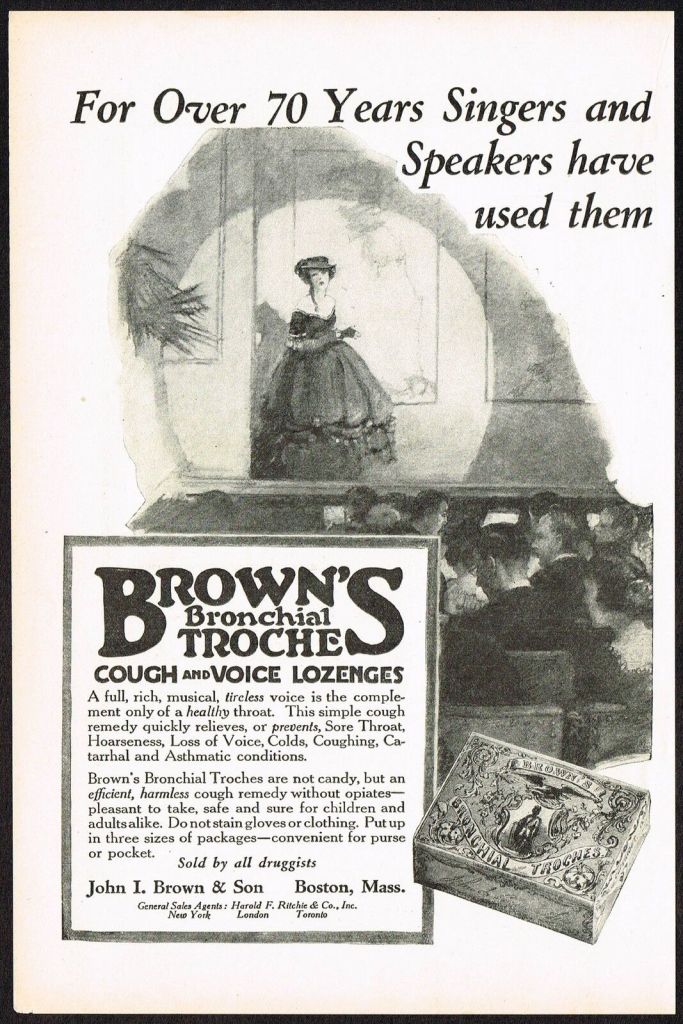
Amongst a list of satisfied customers nationwide, the President of the Massachusetts Senate seemed to be its best promoter. Dr. A. A. Hayes, chemist and state assayer from Boston, Massachusetts published that the content ingredients of the lozenge “contain no opium or anything injurious.”
From speakers to singers and state dignitaries across the nation and abroad, the potent throat lozenges made its way into the hands of people from every social circle.
Image Source: Ebay.com 1920s Original Vintage Browns Cough Lozenges Bronchial Troches Art Print Ad
In the words of the President of the Massachusetts Senate:
“State House, Senate Chamber, Boston, Dec. 21, 1860
Gentlemen, Your Troches are too well and favorably known to need commendation, but I will merely say that I have used them frequently during the past five years, and regard them as the best preparation known to me for the vocal organs.
I am truly yours, CHARLES A PHELPS, Pres. Mass. Senate.”
Brown retired in 1870 and died in 1882 at 92 years old.
Image Source: The Library Company of Philadelphia
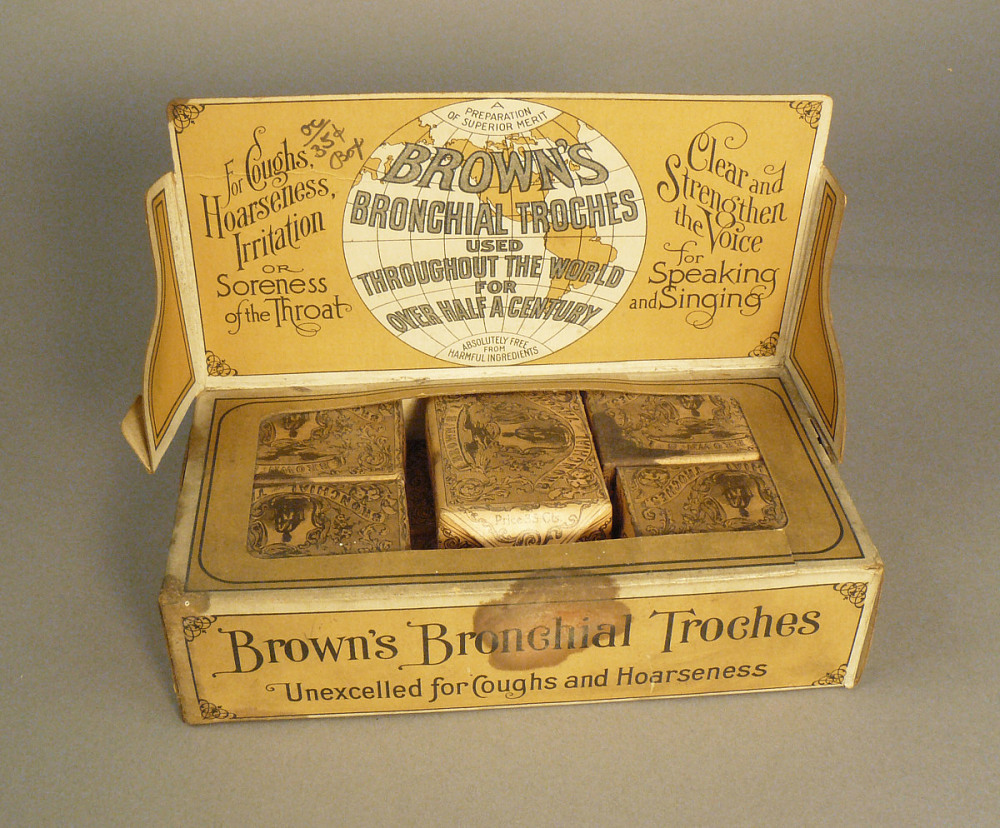
References: http://www.stackbowers.com; The Library Company of Philadelphia, http://www.digital.librarycompany.org; The Atlantic Monthly, January 1924; Ebay.com 1920s Original Vintage Browns Cough Lozenges Bronchial Troches Art Print Ad; The Library Company of Philadelphia, http://www.digital.librarycompany.org;
 The Dash