Written by Victoria Gresham | June 30, 2023
The Z-Men of the Sea
America’s history is laden with scars of battle and war. Over the years, countless men and women gave their lives to protect our country. They served in various capacities, some known while others not as much. One “forgotten” service was the United States Maritime Service (USMS), which was established in 1938 under the Merchant Marine Act of 1936. The volunteer service organization was created to train individuals into becoming officers and crewmembers on merchant ships during wartime.
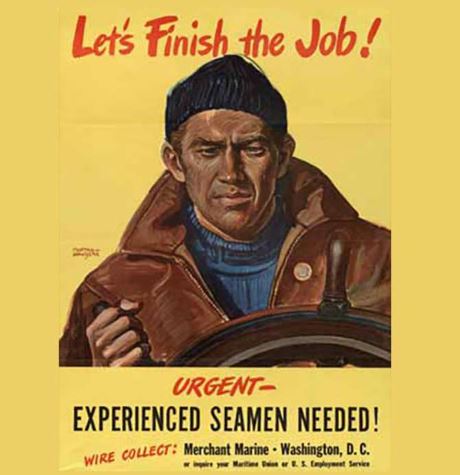
During World War II, the United States had an estimated population of 130 million people. The Merchant Mariners put 16 million into uniform, which placed 12 1/2 percent of the populous into service. Due to the demand for hands to manage the merchant ships, the Merchant Marines began taking recruits as young as 16 years old.
Photo Credit: US Merchant Marine recruitment poster, 1944, National Archives.
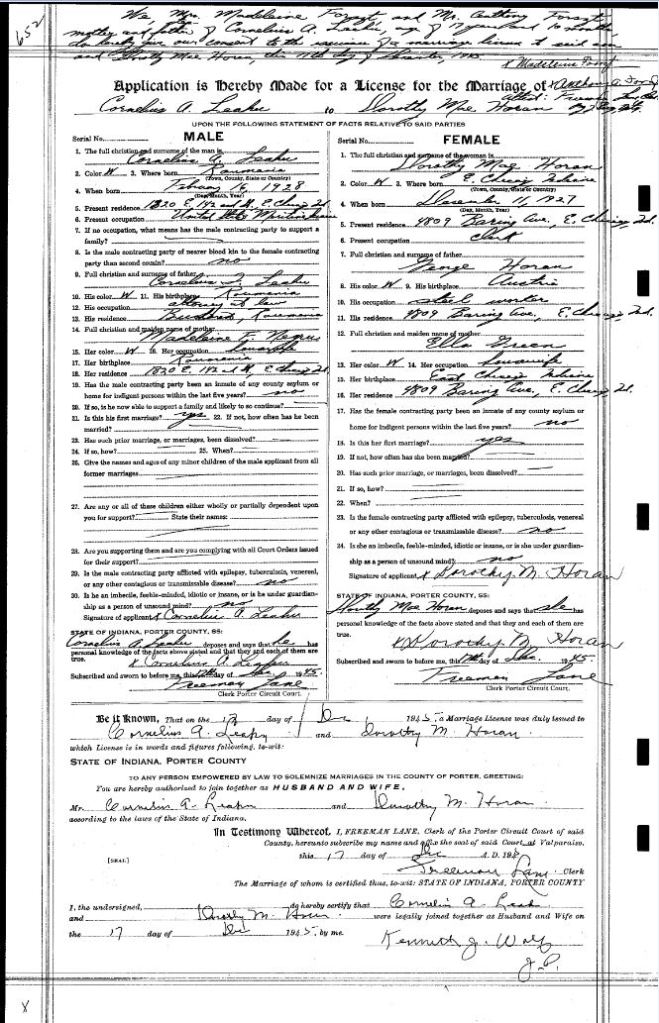
Cornelius A. Leake was born in Romania on February 16, 1928 to his parents, Cornelius I. Leake, an attorney at law residing in Bucharest and Madelaine F. (Negru) Leake, a housewife. During his youth, his mother was remarried to Anthony Forazt. The family left Romania and moved to Indiana to establish their home on the 142nd block of East Chicago. After living in the United States, young Cornelius made a decision of his lifetime. He opted to serve his new country- the United States- as a Merchant Marine.
He was only 17 years old when he served with the United States Maritime Service. But that wasn’t the only life-changing decision young Cornelius made during his adolescence. In 1945, he sought to wed Miss Dorothy Mae Horan to be his young bride. Dorothy was 2 months older than Cornelius. Although she was a native to Indiana, having been born in East Chicago, her father, George Horan, was born in Austria. Dorothy’s mother, Ella (Green) Horan was born in East Chicago. Her father, George, was a steelworker while her mother, Ella, a housewife. The two families found a place in time to call America their home.
Going off to war for men was nearly unavoidable in those days, but the rising demand for troops made it necessary to reach deeper into our country’s human resources. Recruits across the nation became younger and younger to the point that all the service branches were recruiting teenage boys. The State of Indiana was no exception and had its share of sending its youth off to war.
Although these boys were not old enough to drink, smoke, or even vote- they were old enough to fight and sacrifice their lives for our country. It wasn’t unusual for these youngsters to marry before being deployed to some far off country. Having their sweetheart back home waiting for their return may have brought them comfort while on their long journey. However, since they were still considered underage, these minors were too young to marry without the consent of their parents to tie the knot, like young Cornelius.
Cornelius and Dorothy completed their marriage license application in Porter County even though they both lived in East Chicago, Lake County. Back then, the marriage laws allowed them to apply in either county. They initiated their application in Porter County since they were wed by Kenneth J. Wolf, Porter County Justice of the Peace in Porter County.
“We, Mrs. Madelaine Forzt and Mr. Anthony Forzt, mother and father of Cornelius A. Leake, age 17 years old 10 months, do hereby give our consent to the issuance of a marriage license to said son and Dorothy Mae Horan, this 17th day of December, 1945.” Signed by Madelaine Fortz; Anthony Forzt; attested by Freeman Lane, Clerk of the Circuit Court.
Cornelius and Dorothy were wed the same day. Up to that point before Cornelius and Dorothy contemplated nuptials and kept their innocence on the school playground, the world cried out a different message than the sweet sounds of childhood bliss.
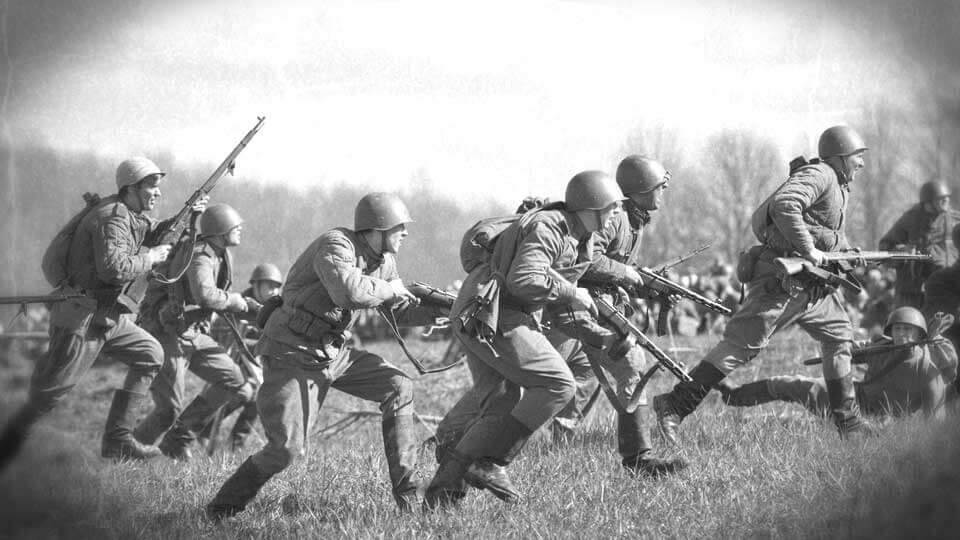
Six years had passed since Adolph Hitler became chancellor of Germany on January 30, 1933 when World War II broke out on September 1, 1939. Germany had invaded Poland, which brought its allies, Britain and France to declare war on Germany. By September of 1939, Germany had worked with Soviet leader Joseph Stalin to secure a part of Polish territory. While Germany captured Warsaw, the United Kingdom defeated a German pocket battleship at the Battle of the River Plate, becoming the first major naval engagement of World War II. Germany continued to fight its way to dominance over the next 6 months by fiercely invading Norway, Belgium and Paris. During July 10-October 31, 1940, Britain fought for its life as German bombers rose up against British fighters as an introduction towards a German invasion.
Hostility, chaos and destruction loomed around the world. On December 7, 1941, the United States was plunged into war after Japan made a brutal attack on Pearl Harbor. Adolph Hitler declared war on America 4 days later sensing a weakness in the nation’s foothold. The next four years would wreak havoc in our country, which in the end would take an estimated 420,000 lives total of civilian and military deaths. Over 12,000 civilian deaths would be contributed to crimes of war and military activity such as bombings.
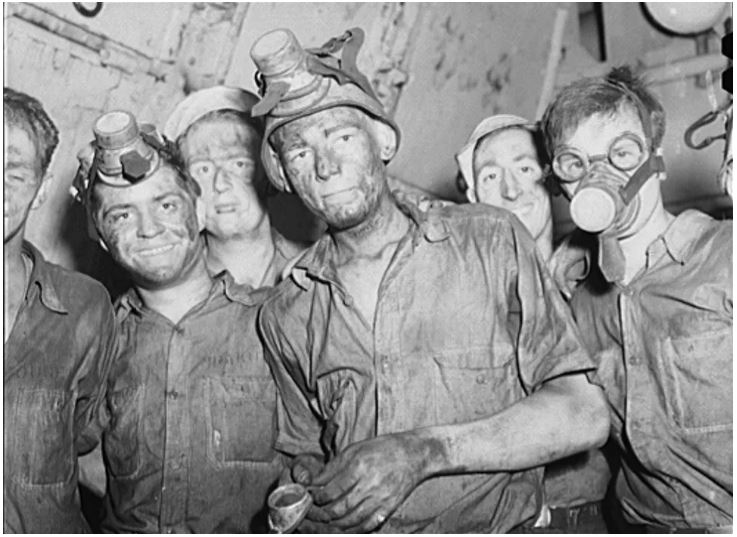
Merchant Mariners aboard a training ship working in the boiler room.
Farm Security Administration Office of War Information Photograph Collection (Library of Congress)
Again, alas, young Cornelius. He was prepared at the tender age of 17 years old to change the trajectory of his life. He came to the United States leaving his mother country, Romania, ready to call it his own. Other boys were ready to claim their right to passage by taking up arms to defend our country as well. Although not yet the age of majority, but old enough to enlist and take a bride, with consent of their parents. Amongst them included Harold Loren Abegg, (U.S. Army) who married Jacquelyn June Loney, both of Gary, Indiana; and Clifford G. Harrison (U.S. Marines) claiming his bride, Melva Jean Garrison respectively of Hammond and East Chicago, Indiana. Countless teens flocked to Porter County to wed before leaving their families behind to serve Ol’ Glory.
While our distinct branches of armed service grew in numbers of its younger soldiers, the Merchant Marines played a critical part in the war made up entirely of civilians. Merchant Mariners were the supply line that provided virtually everything Allied armies needed in order to survive and fight on foreign battlefields. They played a huge role in our country’s shipping expeditions since its purpose was to assist with military operations. While technically not part of the military, it is managed by the Department of Transportation’s Maritime Administration in support of our military service.
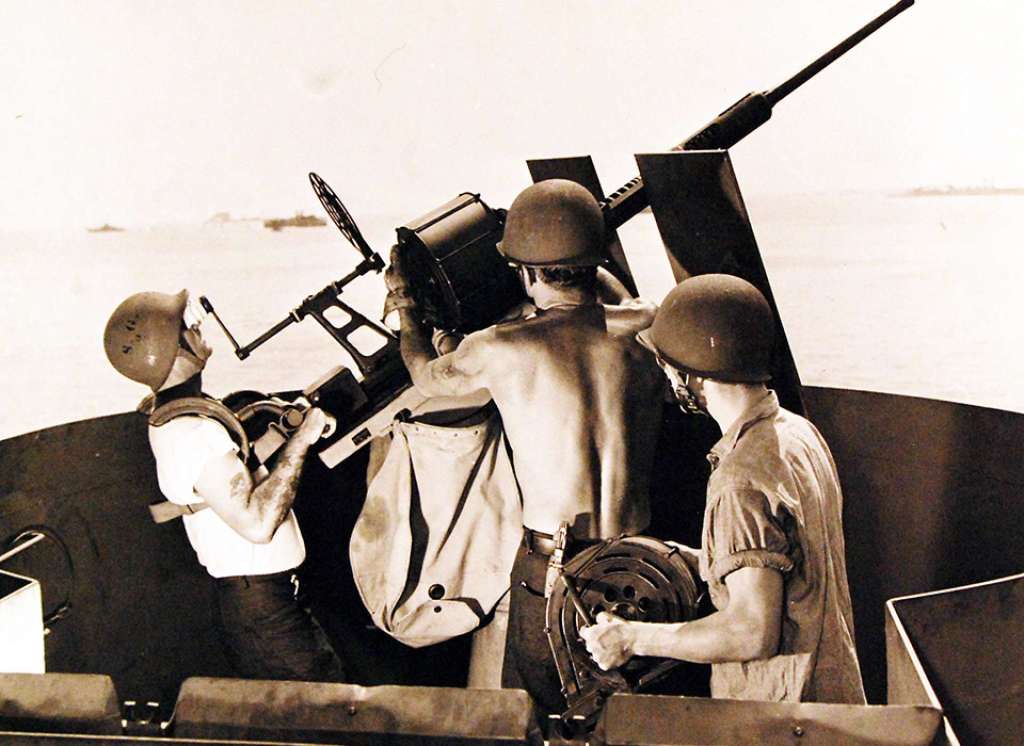
Merchant crew and Navy Armed Guard practice operating a 20mm gun onboard ship. Courtesy of the National Archives.
The Merchant Marines first made a name for themselves during the Revolutionary War by capturing the British ship, the HMS Margaretta. Moving forward, they were officially licensed to capture enemy ships in every war effort. During World War II, the merchants were given Navy guns to defend their ships, but unfortunately 3.1 million tons of merchant ships were lost in the war. Mariners died at a rate of 1 in 26, making it the highest casualty rate of any branch of service at the time. Nearly 250,000 civilian merchant mariners supported the U.S. military by delivering supplies and transporting armed forces personnel to foreign countries engulfed in the war while surviving countless torpedo attacks. The U.S. Merchant Marines, also called a seamen- had no military standing or government benefits back then, but served with an unusual trait of courage and gave their lives sacrificially as those in the armed forces. It would be decades before the mariners would be recognized as veterans.
“Did you ever hear of the Z-Men? Sounds like a gag, doesn’t it?” Bob Hope once asked his audience over a Christmas radio broadcast in 1944. “Well it isn’t,” he continued. “Z-Men are the guys without whom General ‘Ike’s’ army and Admiral Nimitz’s navy couldn’t live…Z-Men are the men of the Merchant Marine.” Their nickname drawn from their required identification papers, also known as a Z-card.
In the end, a total of 9,521 seaman lost their lives while 609 mariners were captured as prisoners of war during World War II. This number held a significantly higher percentage compared to those killed in any military branch between the years of 1939-1945.
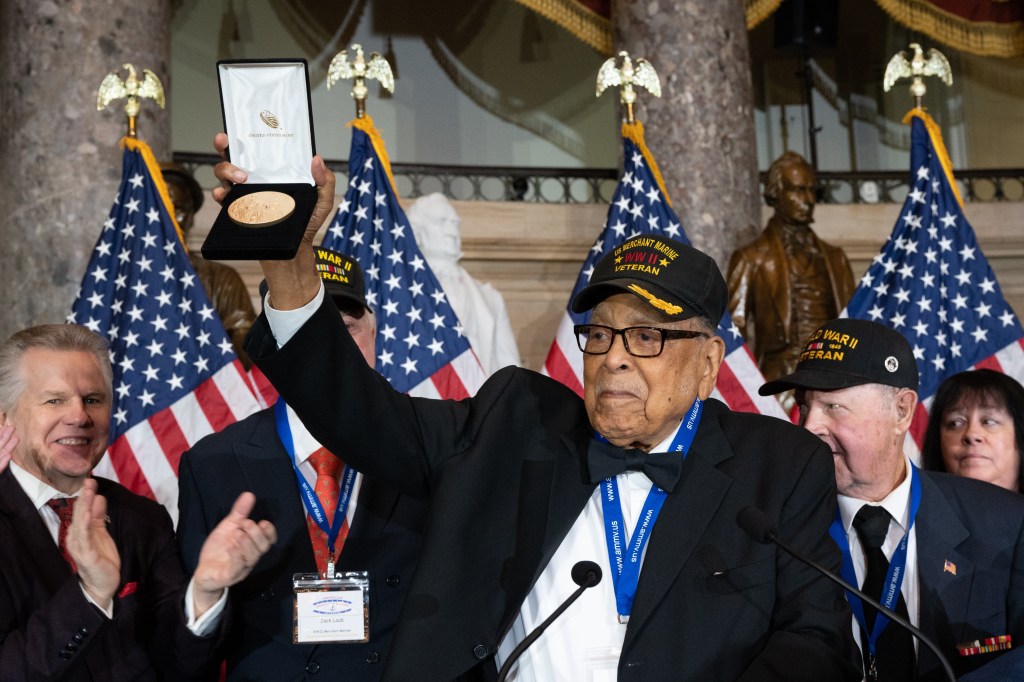
Nearly 10 years after the war ended in September 2, 1945, the United States Merchant Marine Service was mostly dissolved by the end of 1954. It currently remains active through the Department of Transportation. The service continues to operate by actively commissioning officers from their enrollment of men and women in the United States Merchant Marine Academy located at Kings Point, New York to lead roles as administrators and instructors. In 2020, Congress passed the Merchant Mariners of World War II Congressional Gold Medal Act to recognize the Merchant Mariners for their courage and contributions during the war. On May 18, 2022, the Congressional Gold Medal was awarded to the U.S. Merchant Mariners of World War II, who played a crucial role in the country’s war effort. As of 2022, there were approximately 167,000 living World War II veterans in the United States alone; some started out as young boys, but in the end were molded into men.
References: Defense.gov; smithsonianmag.com; nationalww2museum.org; sagu.edu; mybaseguide.com/merchant-marines; Wikipedia.com; Porter County Clerk Archives; pbs.org; National Archives, http://www.archives.gov/research/military/ww2

 The Dash