Written by Victoria Gresham | July 28, 2023

THE WINNIES
What did Victoria Taylor, Florence DiTullio and Consuelo Poland have in common? One thing for certain is that they each shared a unique external trait. Victoria Taylor was born in California on September 27, 1902 to parents, Garcia Bustista and Sarah Veloz, both immigrants from Spain. In 1946, Victoria lived in Chicago, Illinois and met Conrad Julius A. Michaels. Conrad was originally from Westchester, Indiana and had moved to Chicago, Illinois during the 1930’s. Being amid World War II, Conrad registered for the military draft on October 16, 1940 before meeting Victoria.
In 1946 after the war ended, Conrad made his living as a locomotive engineer. On the other hand, Victoria found herself being stably employed in one of the nation’s fastest growing industries for women at the time. Although they lived outside of Indiana, the couple chose to apply for a marriage license at the Porter County Clerks office on March 30, 1946 and wed the same day.
Photo credit: Porter County Clerk Archives, by Victoria Gresham, March 28, 2022

At the end of World War II, men returned home to their families in hopes of starting their lives from where they left off before the war. However, the war had many changes on the home front, including the way it impacted the labor force- and the women in it. Victoria was part of a booming working class that was predominantly held by men. But that would no longer be the case.
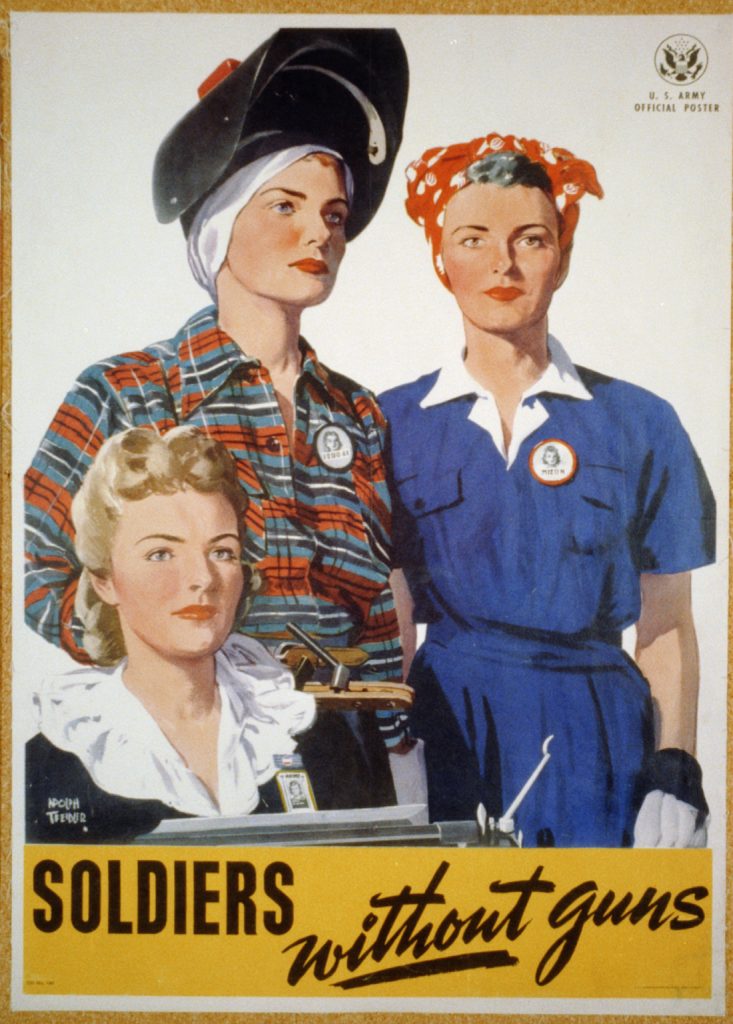
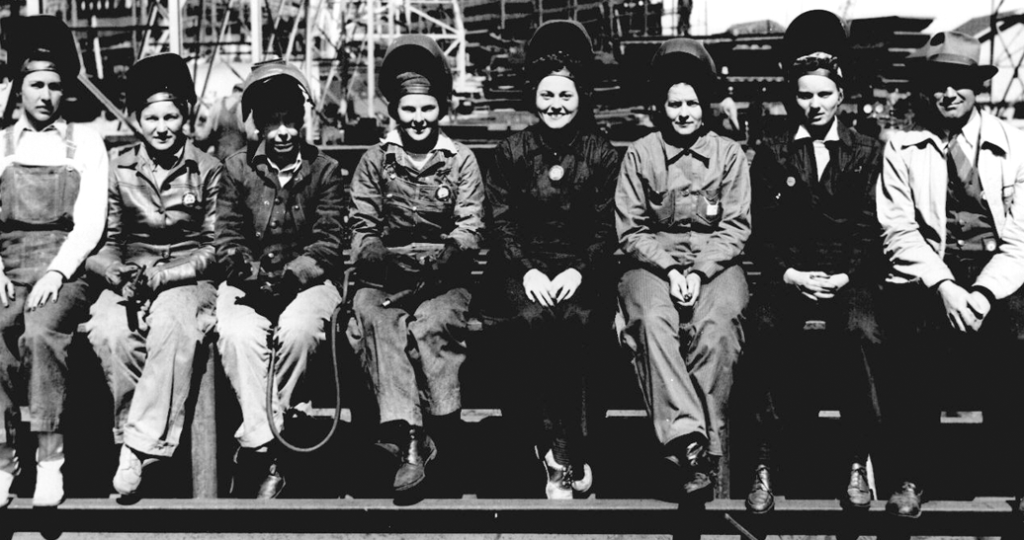
During World War II, 28,000 “Wendy the Welders” cousins of the better-known Rosie the Riveter – were picking up their torches across the nation and had changed the scene of the workplace. Many found themselves working in the Vancouver’s Kaiser Shipyard. These torch bearing women turned steel plates into troop transports and aircraft carriers at a staggering pace, averaging nearly one a week.

The new entourage of women welders were also known as “Winnie’s.” The original “Winnie the Welder” was Florence Joyce “Woo Woo” DiTullio, who was a former shipbuilder at the age of 20 years old. She built ships alongside the men at the Fore River shipyard in Quincy.

“I was a curvaceous 119 pounds. Every time I walked by, the guys would go, ‘Woo Woo!’” she recalled with a laugh. She got her start in 1941 at being the first woman hired on as a welder through her uncle, Daniel Libertini, who was a sheet-metal worker at the shipyard. When she heard that they were recruiting women for hire, she left her job as a nurse’s aid to try something different. At that time, women had to take a Navy test that included welding a metal bar. She and other women vying to make a difference soon began training on the skill of tack welding. Approximately 2,000 women during the war were nicknamed “Winnie” when they worked in the shipyard.
A NEW WORKFORCE
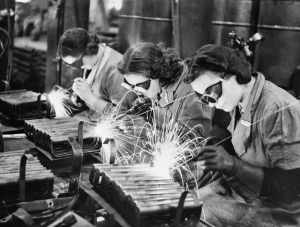
During World War II, while men were shipped overseas to fight, thousands of women were being recruited to work and many of them took over the welding industry. Other women flocked to fill more industry roles during the war and did not hesitate to do their part in the war effort by joining the labor force. “Rosie the Riveter” and “Winnie the Welder” were soon joined by “Susie the Steelworker,” whose signature work pants and goggles made her stand out. “Susie” debuted at a Carnegie-Illinois steel plant in Gary, Indiana in March of 1943, while a Boston shipyard dubbed and recruited their version of “Elsie the Electrician.”
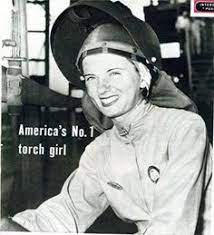
Other notable women welders beyond Joyce “Woo Woo” were Vera Anderson, a young female welder employed at Ingalls Shipbuilding in Pascagoula during WWll. Vera was 19 years old when she competed against female welding champions from Oregon and California. In 1944, Vera, known as America’s No. 1 torch girl, won the title in the first Women’s National Welding Championships, along with $350 in war bonds and a trip to meet Mrs. Roosevelt at the White House. She dominated the contest, which was based on speed, workmanship and quality.
Photo credit: Vera (Anderson) McDonald; by www.msmaritimemuseum.org
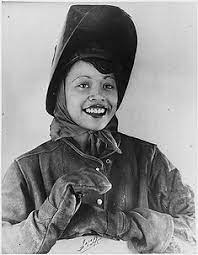
In addition, history made a place for Miss Gladys Thues, who was one of the fastest and most efficient welders at Kaiser Company Permanent Metals Corporation yards near Oakland California. She welded until her time ceased when victory was won in 1945.
Photo credit: Miss Gladys Thues, by http://www.toughtinywelders.ca
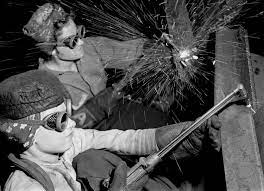
By 1944, women welders were actively building ships, aircraft, vehicles, weapons and equipment for the troops. During the war, women in every industry dominated the workforce with a stronghold of 65% of the labor force. The number of women in the work force ballooned 50 percent between 1940 and 1945. The average weekly wage for female skilled workers in 1944 was $31.21; the average for comparable males was $54.65.
Unfortunately, when the war ended, the women lost their jobs when the men returned home from the war. To recognize all the women that served in the nation’s defense, we honor them all during the observance of “National Rosie the Riveter Day” on March 21st. Riveters, welders, electricians, inspectors, mechanics, chemists, drill press operators, steelworkers, and typists all had key roles in paving the way for women today in those fields and beyond.
Predictions state that by the year 2024 about 400,000 experienced welders will have retired. Employers are seeking to fill labor shortages and encourage gender diversity in the workplace. Between 2016 and 2019 the women that entered the welding industry increased by 30% in the field. In 2020, women welders made up 3.8% of the welder workforce and currently account for over 6% of the welders in the industry.
LATINAS WELDING GUILD: Women Welders in Indiana
Standing on the shoulders of the Winnies of yesteryear is Consuelo Poland, who at age 29 years old founded the Latinas Welding Guild located in Indianapolis, Indiana in 2018. Consuelo was introduced to welding during her studies at Kendall College of Art and Design located at Grand Rapids, Michigan. Consuelo, who was adopted from Guatemala, wanted to bring more awareness of the welding industry to women in Indiana. As founder of the Latinas Welding Guild, she enrolled her first cohort with 5 women back in 2018, which was a combination of Latinas and other women from various ethnic and economic backgrounds.
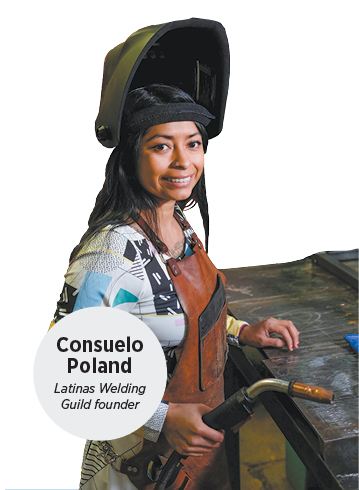
The guild offers an introduction welding class that teaches its students how to set up the machines and prepares them to take the welding test to become a certified welder. The class doubled by its second year and continues to thrive with growing interest by women of all ages.
Although decades have separated Victoria, Florence and Consuelo from each other, their determination to prove themselves capable of mastering a craft once performed by men will ensure their place in time.
Photo credit: Consuelo Poland, Latinas Welding Guild; by http://www.ibj.com
References: http://www.roadsideamerica.com; http://www.gray.com; http://www.patriotledger.com; http://www.familysearch.com; Indiana, World War II Draft Registration Cards, 1940-1947; The Home Front and Beyond: American Women in the 1940s by Susan M. Hartman; Winnie the Welders/heinzhistorycenter.org; http://www.toughtinywelder.ca; ibj.com; http://www.msmaritimemuseum.org; http://www.insider.com; http://www.medium.com
 The Dash