Written by Victoria Gresham | August 30, 2023
Knock, knock. Who’s there? Indiana
Early postal service in the State of Indiana was quite different from how its perceived today. Census records during the early 19th Century would list Indiana residence in an abbreviated format of the initials, “IA,” which is not as recognized as the current abbreviation of “IN” for the state. Often the abbreviation of “IA” has been mistaken for Iowa and not for Indiana, but in the early stages of the Union, the State of Iowa didn’t exist yet.
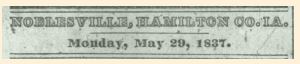
Source: Indiana; From IA to IN and Early Postal Service in the State wediggeneaology.com; Noblesville, Hamilton County, IA (Indiana) Dated Monday, May 29, 1837
The Post Office Department, which was the precursor of the U.S. Postal Service, officially abbreviated Indiana as “Ia” between 1831 and 1874, until the abbreviation was changed to “Ind.” The 1850 U.S. Federal Census was the first record for the new abbreviation as the Indiana residents’ place of birth. Yet, by the time Porter County was established in 1836, the Porter County Clerk began receiving mail with the newer abbreviation of “Ind.”
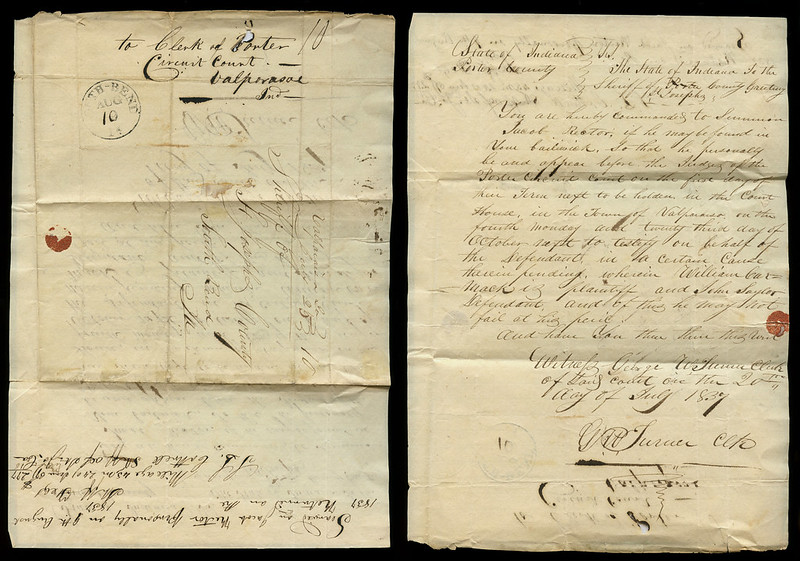
Source: Porter County, Indiana’s Earliest Known Postal Cover Dated July 25, 1837 – Valparaiso, IN (Collection: Steve R. Shook)
Before 1847 when the Post Office Department issued its first postage stamp, individuals would take their letters to a local Post Office, where the postmaster would hand stamp or write, known as “ink,” the postage amount in the upper right corner of the letter. The postage rate was determined on the number of sheets of paper in the letter and how far in distance the letter would travel.
As time passed, postage stamps became a common sight on correspondence to the Porter County Clerk’s office. In 1898, the cost of a postage stamp was 2 cents. The red stamp displayed the image of first president, George Washington. The stamps were also known as U.S. Revenue Stamps. When the Civil War erupted in 1861, America was on the brink of bankruptcy. The government initiated a plan to generate internal revenue by taxing domestic goods, such as tobacco, alcohol, medicine, perfume, playing cards and legal documents. By 1862, the U.S. Internal Revenue Service issued a printing contract to Butler & Carpenter of Philadelphia to produce the revenue stamps as an effort to raise revenue for the war. The revenue stamps remained in circulation until they were abolished in 1883, after the funds were raised through the tax to pay down the accumulated Civil War debt.
The Lake County Clerk of the Circuit Court located in Crown Point, Indiana mailed a deposition taken for the matter between Emil Kutsche, Plaintiff against George H. Hammond Co., Defendant, for the total cost of 8 cents in postage affixing to the envelope the appropriate amount of revenue stamps to cover the postage costs. The deposition was taken in the presence of James P. Harrold, Notary Public, in Cook County, Illinois. The item was then forwarded to the Porter County Clerk of the Circuit Court to be added to the case file that had once set in Lake County Circuit Court.
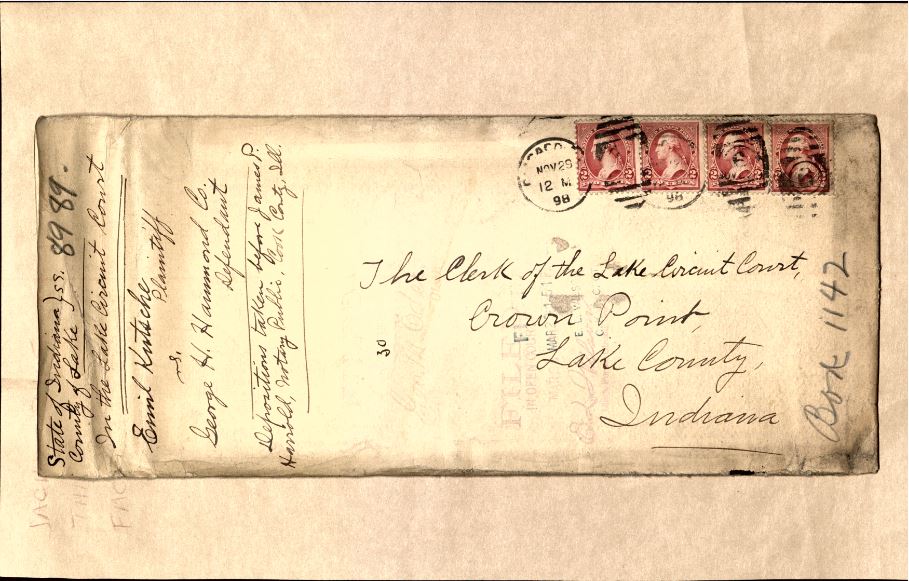
Source: Porter County Clerk Archives Department; Deposition in the matter of Emil Kutschke, Plaintiff v.s. The George H. Hammond Company, Defendant; Postage stamp valued at 2 cents per ounce. Photo by Victoria Gresham, Archives Coordinator, Dated October 5, 2023
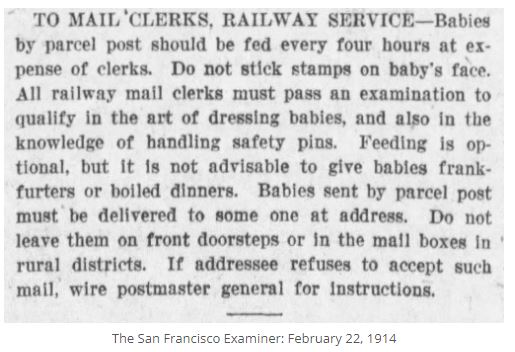
The US Postal Service introduced the parcel post system on January 1, 1913. Postal customers could ship items such as eggs, produce, baked goods, fresh meals, live bees, and small livestock. Indiana also became a participant in the new era of postal services and had its share of oddities. However, the most peculiar package ever shipped in the United States was a small child.
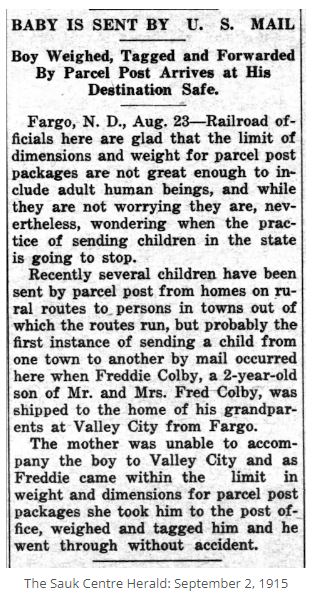
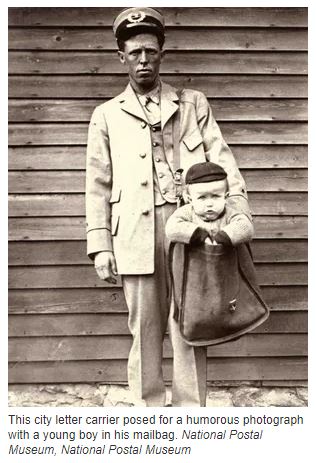
Although an oddity, babies and children were once shipped to their destinations with the help of the United States Postal Service. Since the late 1800’s, rural America comprised 54 percent of the country’s population. It was common for farmers to travel for days to the nearest post office to retrieve their mail; however, the parcel post became a welcomed service once the convenience was introduced to rural residents. Patrons soon enjoyed the ease of how it brought goods and commodities directly to their front door, including these lively bundles of joy.
The first Post Office in Porter County was located one mile east of Chesterton and known as Coffee Creek on January 29, 1835; however, Porter County was still part of LaPorte County at that time and had not been divided from it. In December of 1849 the name was changed from Coffee Creek to Calumet, which became the Village of Calumet to later be known as present day Chesterton.
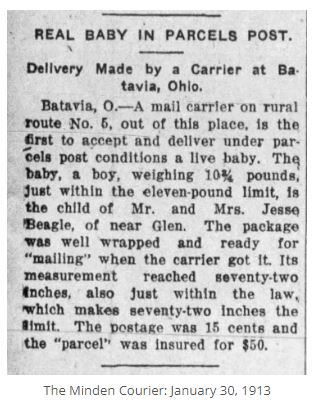
Americans were creative with their ways of saving a dollar by using the postal service. The first incident of frugal means was by an Ohio couple, who shipped their son to his grandmother’s house about a mile away using the parcel post system in January, 1913 when the system first launched. Jesse and Mathilda Beagle paid 15 cents for postage and insured their 8-month-old son, James, for approximately $50 before handing him over to the postman for delivery to his grandmother in Batavia. Since there was no regulation against shipping a child, parents began to test the limits of the system as an alternative form of transportation.
Two years later, a Florida mother mailed her six-year-old daughter from her home to Virginia destined for her father’s residence that was located 720 miles away. According to Nancy Pope, head curator of history at the National Postal Museum, the trek is recorded as the longest postal trip by a child at a cost of 15 cents in stamps.
Within the first week of operations, 1,594 post offices reported handling over 4 million parcel post packages with the new system. Companies caught on how to market their wares through parcel post, which gave a huge boost to the developing economy. Customers quickly discovered the cost-saving benefits of ordering supplies and goods from the comfort of their homes to be delivered to their doorstep rather than traveling for their home essentials. Rural America was the largest consumer of the service since many towns and villages did not have complete access to the early railways nor developed roads for commerce.
The weight of a parcel post package could not exceed its regulated weight limits, starting between 4 to 11 pounds. Patrons were creative in utilizing the new parcel post system. In 1913, only a couple of days into the new system, one customer shipped 1,000 paving bricks that were individually wrapped and addressed to its destination. Each brick was cleverly mailed from the Gary, Indiana Post Office as separate samples to comply with shipping regulations.
In 1916, the Bank of Vernal, Utah began its construction of its new bank in a similar manner. Utah’s “Parcel Post Bank” was accredited to the parcel postal system after its 80,000 textured bricks were delivered in small bundles from Salt Lake City to its construction site in Vernal to avoid the higher freight charges. Since the city did not have access to the railway nor did it have any paved streets connecting the two cities, mailing the bricks allowed the construction project to be completed at four times less the cost of freight charges.

Source: Porter County Clerk Archives Department; Correspondence to Honorable Don N. Laramore, Judge of Starke County Circuit Court, Knox, Indiana from Porter County Clerk of the Circuit & Superior Courts, Valparaiso, Indiana. Postage stamp valued at 3 cents per ounce. Photo by Victoria Gresham, Archives Coordinator, Dated October 5, 2023
By July 1, 1863, the cost of postage had increased from 2 cents to 3 cents per stamp. The Porter County Clerk began using the new 3 cent purple postage stamps bearing the image of Thomas Jefferson to mail legal documents and correspondence. Since attorneys used the postal system as their means of delivering documents to the Clerk’s office, the clerk staff would be responsible of forwarding those copies to individuals involved with a case. Sometimes a case would be assigned a Special Judge from a different county and would need copies of the case documents from the Clerk. The Clerk would affix multiple postage stamps to cover the postage costs per ounce. A letter addressed to the Honorable Don N. Laramore, Judge of Starke County Circuit Court, Knox, Indiana weighed at least 4 ounces and required 12 cents postage to ship the letter.
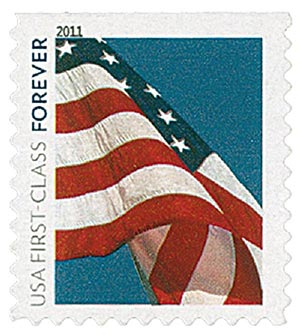
The 3 cent Jefferson stamp held its value for a long duration and did not increase again until August 1, 1958 at a cost of 4 cents per stamp. During the Vietnam War in 1963, a postage stamp cost 5 cents per ounce maintaining a minimal rate of increase since the Civil War era. Since 2011, all first-class stamps have been “Forever” stamps. The stamps remain valid regardless of price increases. Effective July 9, 2023, the cost of postage now sets at 66 cents per ounce.
 The Dash