Written by Victoria Gresham | September 25, 2023
Women Serving as Justice of the Peace
Beginning in 1820 during the State of Indiana’s earliest settlement, Justices of the Peace (JPs) were constitutional officers who served five-year terms as part-time magistrates. Each township in Indiana elected a Justice of the Peace, who did not have to be a lawyer. The Justice of the Peace headed one of Indiana’s earliest courts of justice.
Justice of the Peace courts were structured to give every citizen easy access for the ability to file a claim within the court system without an attorney. Justice of the Peaces had countywide jurisdiction over marriages, petty crimes, civil cases involving real and personal property of small value, and, later, traffic violations. A justice also could issue “peace bonds,” which is like a temporary restraining order. Township constables worked in joint with a local Justice of the Peace to serve summons and enforce court orders as issued by the JP courts.
The General Assembly enacted legislation calling for statewide changes in the Justice of the Peace system in 1957 and 1959, but both laws were found unconstitutional. By the 1960’s, changes in the judicial system left the justices primarily responsible only for marriages by the 1960s.
A 1970 statewide referendum removed the capacity of Justice of the Peace as a constitutional official, which led to a 1975 state law that abolished all Justice of the Peace courts.
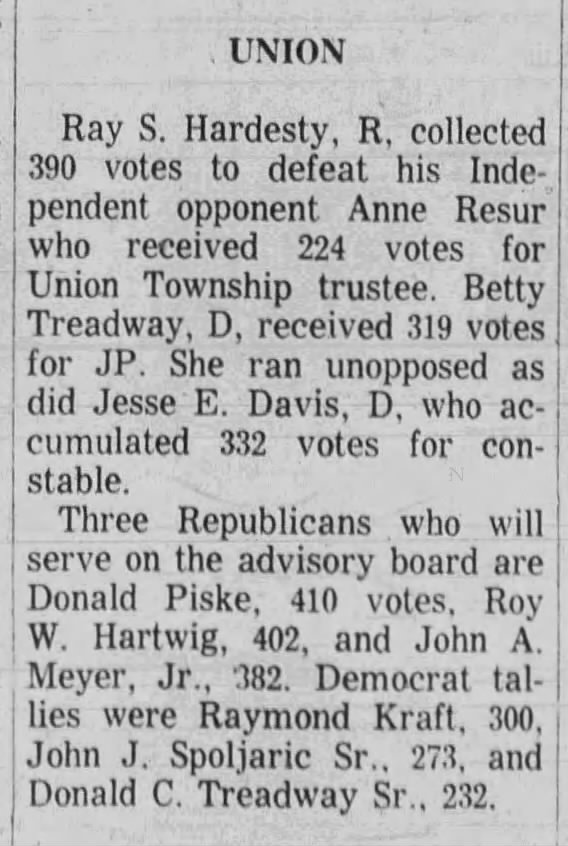
Betty Treadway, Democrat Candidate, was elected as the Union Township Justice of the Peace on November 04, 1970 during the November elections as reported by the Vidette-Messenger, dated November 4, 1970 listed in the Second Section on page 11. Betty ran for her seat unopposed and received 319 votes. That same year, Jesse E. Davis, also running on the Democratic ticket, ran unopposed for constable and had accumulated 332 votes.
Betty became part of an elite group of women Justice of the Peace in Porter County. Before her, two others took the gavel, some out of aspiration and others out of rising to the call. Mrs. Edna Wilkes was a Liberty Township Justice of the Peace from 1939 to 1946. Known as the “flying Justice” since she held a pilot’s license. She was defeated in the 1949 primary in her bid for re-election. Mrs. Beverly Squires became the second woman JP in Porter County. Beverly was “filling the shoes” of her late husband, Robert, who passed away unexpectedly on November 13, 1956 leaving his JP post vacant. She appeared before the Porter County commissioners and requested that they appoint her to serve out her husband’s remaining term, which would officially end in 1959. She received the approval of the commissioners for the Union Township JP office. She then received her commission from Gov. Greg on Dec. 30th.
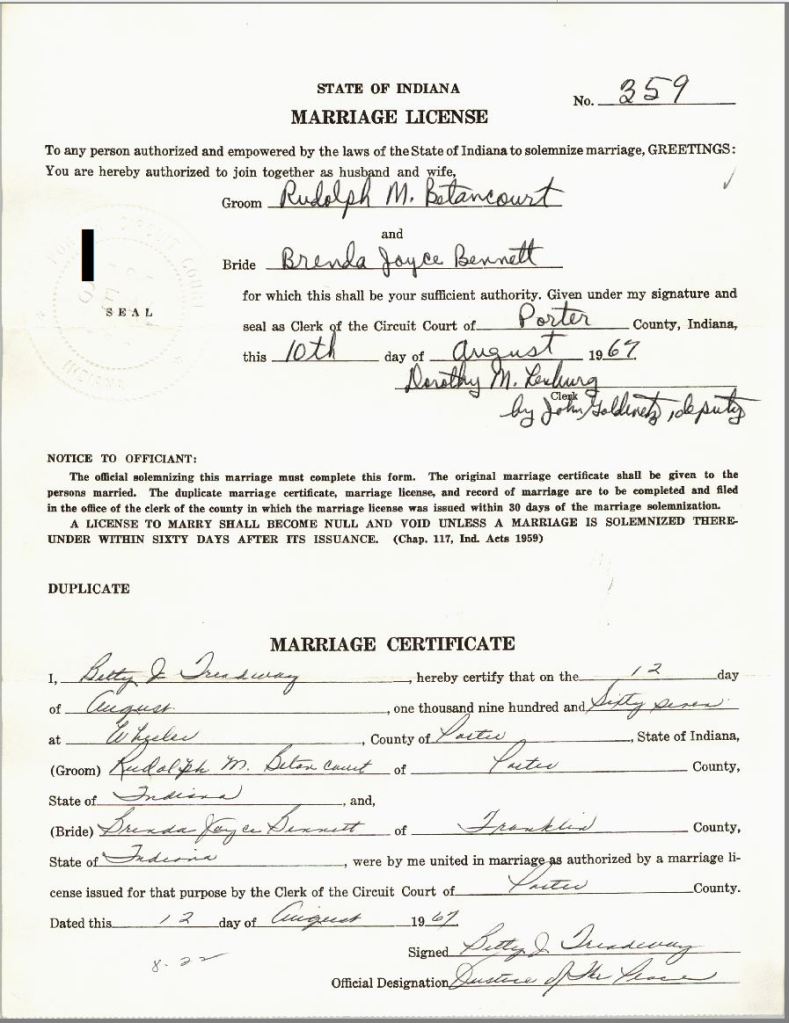
Betty Treadway officiated dozens of marriage ceremonies as a JP including the nuptials for Robert E. Miller and Ramona L. Hazlett; Jerry J. Maul and Roberta P. Weppell; and Rudolph M. Betancourt and Brenda J. Bennett.
While there were far fewer women holding office of Justice of the Peace throughout the state, other female Justice of the Peace during the course of the office’s existence joined the ranks with Edna, Beverly and Betty, such as Naomi Hunt of Noblesville County, who was known to be a longtime Justice of the Peace; and Justice of the Peace, Agnes Mitchell of Cicero, Jackson Township of Hamilton County.
Photo Credit: Porter County Clerk Archives by Victoria Gresham, Archives Coordinator, January 10, 2024
Teen Makes History As Justice of the Peace
In 1974 before the removal of JP’s, Indiana made history by having the youngest Justice of the Peace hold office.
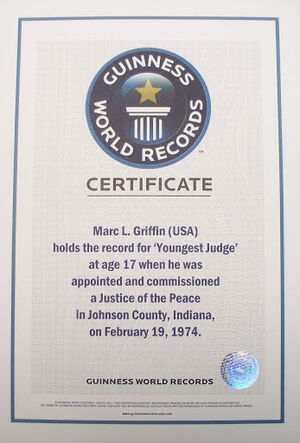
Marc L. Griffin, a 17-year-old high school pre-law student raised a few eyebrows when he became the youngest Justice of the Peace in Indiana. Marc was appointed the role of JP for White River Township by the Johnson County Commissioners. According to the Indiana Attorney’s Office prior statements of the event, there were no age requirements to hold the office of Justice of the Peace. He later completed his education earning a law degree from Indiana University School of Law. Griffin, an avid reader of Indiana law, discovered that it had been more than 50 years since the township filled the Justice of the Peace position. It had sat vacant for that time until he convinced the commissioners to recommend his appointment to the Governor, who in the end, gave him his commission.
Photo Credit: Photo Credit: Marc L. Griffin J.D., August 6, 2020; wikitree.com


Although tension grew as the concern of his ability to serve became the high point of the day when he filed to stay in office during the next year’s Primary Election. Robert W. Conditt, 44 years old, challenged Griffin’s name by filing a lawsuit against Marc’s name being on the ballot. Conditt filed suit against the Johnson County election board prior to the May Primary. According to the Indianapolis Star (1974) Conditt’s was “charging the board that they were in violation of the law when they registered the 17-year-old Justice of the Peace for the election” since he was not 21 years old. Special Judge George B. Davis of the Hancock Circuit Court ruled against Conditt and allowed Griffin’s name to remain on the ballot.
Years later, Marc is recognized in the Guinness Book of World Records as the Youngest Justice of the Peace to ever hold office.
Photo Credit: http://www.wikitree.com World’s_Youngest_Judge-15
Reference: The History of the Indiana Trial Court System, http://www.journals.iupui.edu/index.php/inlawrev/article;
http://www.indyencyclopedia.org/justices-of-the-peace; Indiana Historical Bureau, http://www.in.gov/history/about-indiana-history-and-trivia; http://www.pocomuse.org; https://www.wikitree.com; https://www.abajournal.com/news/article/indiana_lawyer_who_started_his_legal_career_as_a_17-year-old_judge_holds_th
 The Dash