Written by Victoria Vasquez | April 23, 2024
Leading for Change
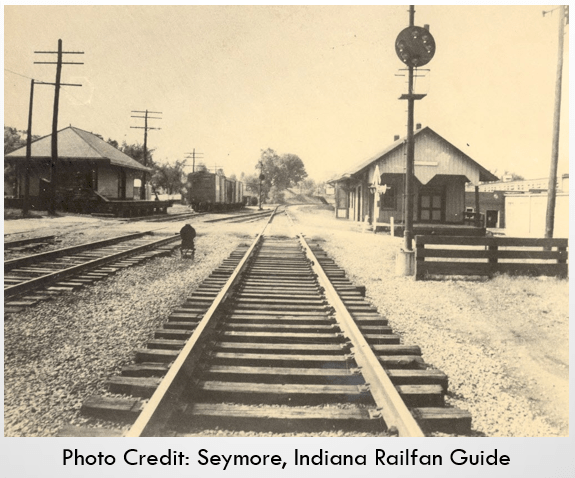
On June 6, 1883 about 2 miles outside of Seymore, Indiana tragedy struck. A fast express train caught in a massive rainstorm traveling from Chicago faced a washout as it screeched over a top soiled track caused by erosion. It was traveling at 45 miles per hour when it flew off the track and destroyed the engine car, baggage car, chair car and pullman’s sleeper. Four railway workers were killed: George Ammons, the trains baggage master was instantly killed with blunt force trauma leaving a wife and family behind penniless without their beloved husband, father and provider.
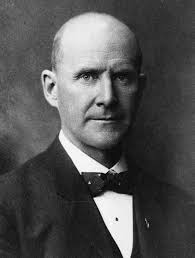
Railroad accidents were a common place in the early days of Indiana leaving scores of horrific injuries and fatalities. The railroad companies were under no legal obligation to help the families of those who were injured or killed on the job. The harrowing reality became a focal point of a young first term state representative from Terre Haute named Eugene Victor Debs. Debs worked diligently to hold the railroads accountable for the welfare of their employees and their employee’s families. Debs legislative crusade was to pick up the torch for those who died or were injured while working on the railroads.
After a successful campaign, Eugene Debs was elected to the House of Representatives in 1884. He was a prominent leader of the Brotherhood of Locomotive Firemen, a union dedicated to the rights and protections of railroad workers. Debs knew first-hand the toll that this kind of work had on a person.
Eugene Victor Debs was a political activist and trade unionist. He was the founder of the American Railway Union in 1894, then later founded the Industrial Workers of the World in 1905. During his lifetime, he inspired millions to believe in “the emancipation of the working class and the brotherhood of all mankind,” which ignited the spark to the industrial unionism era and economic reforms. Debs sought to make changes to the industry, and while his later bids to the White House, 5 times total as a presidential candidate were unsuccessful, he is best known for the changes within the railroad industry and the triumphs he gave to railroad workers and their families.
Photo Credit: Acalanes Union High School District Libraries; Reformers of the Progressive Era
In the Indiana State Health report released in 1883, it showed that railroad accidents accounted for 121 deaths in Indiana or .81% of the total deaths that year. In the prior year, railroad accidents accounted for 72% of the deaths. Almost nothing could be done for the workers who died on the job. They often did not have the resources or legal representation to take on the powerful and growing railroad companies. As the number of deaths increased the need for government assistance and intervention grew more apparent. Historian Clifton J. Phillips noted that by the 1880s, Hoosier legislators were increasingly becoming more concerned about certain aspects of rail transportation within state boundaries, particularly the large number of injuries on the job with the railroad workers.
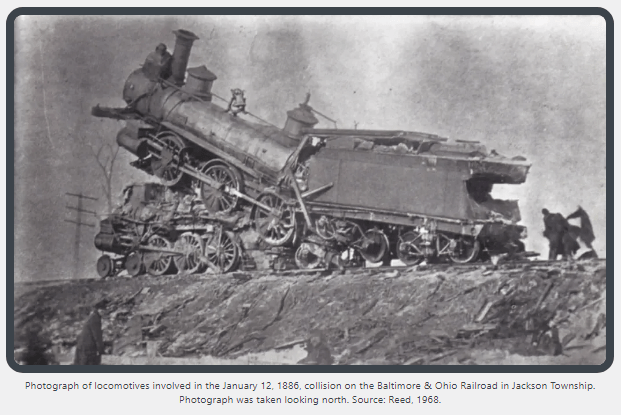
Porter County was not immune to this either. The county had numerous railroad accidents and casualties during its formative years as railroad tracks expanded across the Hoosier state. Some of its victims went beyond the railroad worker. It was not uncommon for the railway to take a life from those daring individuals who would try to catch a free ride on a train car then fall to their untimely death. Other victims of the steel beast were unsuspecting pedestrians who took advantage of walking on the tracks while heading to their next destination. Some would find themselves caught off guard and unable to avoid the oncoming train. Although the final warning whistle was required to blow, getting out of harm’s way was a little too late for many buggy drivers and pedestrians. Train speeds at that time ranged from 45 MPH to 80 MPH at top speeds. Railroad accidents ranged from head on collisions to explosions, to slips and falls from moving or parked box cars.
The oldest railroad incident record held in the Porter County Archives to date is that of Hiram B. Tucker dating back to 1855. Tucker’s body was found on the train tracks in the northern part of the county near Westchester. A jury of citizens was summoned to answer to the account of the tragic incident. Being that there was not a formal means of burial assistance back then, citizens collected amongst themselves enough money to help bury the deceased.
Although it is recorded that E. Thomas spoke up in regards to the financial aspects of the unfortunate circumstance, he opinioned “some of the citizens in this place thinks the Michigan Centrel RR Co had at to pay all this expense. I could not prevail on them to due it and have done as I have stated. I got all I could get and that was ten dollars as shown. By the account, the constable J. Scott, Jury, coroner & witneses is all that remains to setle, and also I think Bush & Welch at not have pay as they belong to Porter Station. Bush is agent & Welch a hand working at Porter station (sic).”
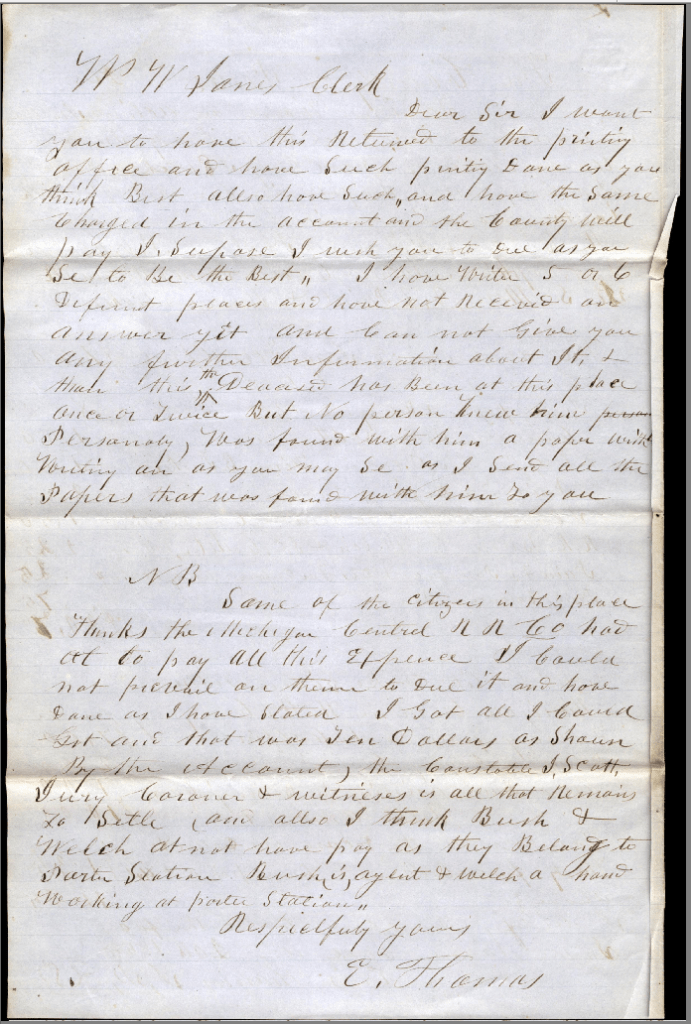
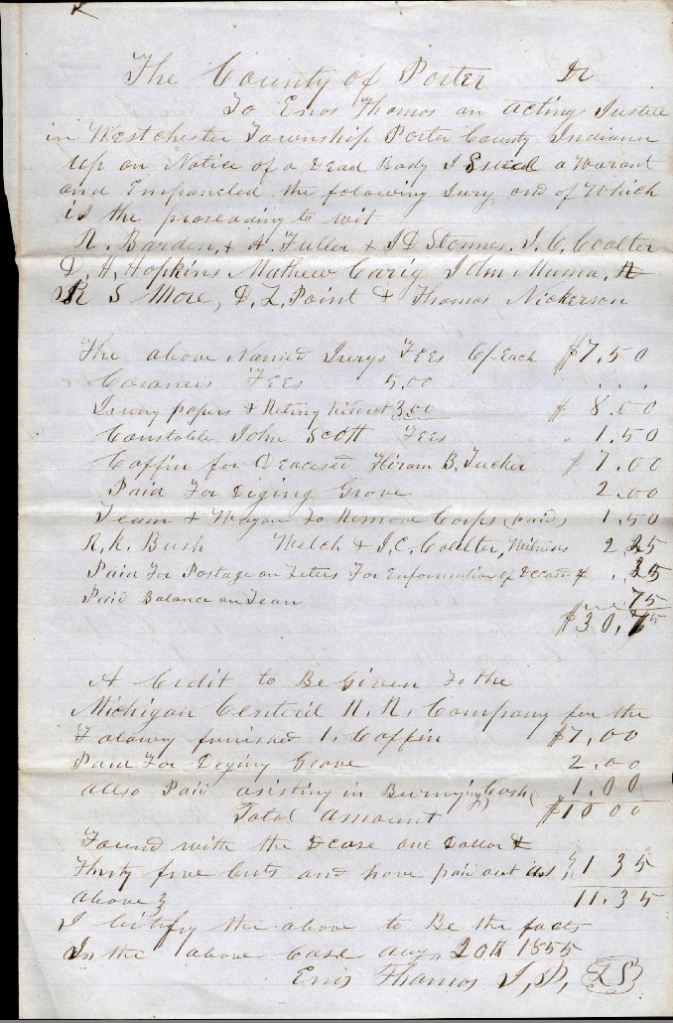
Mr. Tucker was not known by any local resident. According to W.W. Jones, Porter County Clerk of the Court, he made several attempts to reach out to various individuals about the accident through means of correspondences and publications.
“Dear Sir, I want you to have this returned to the printing office and have such printing done as you think best. Also have such and have the same charged in the account and the county will pay, I supose. I wish you to due as you se to be the best. I have written 5 or 6 deferent places and have not received an answer yet and can not give you any further information about it other than this, the deceased has been at this place once or twice but no person knew him personaly, was found with him a paper with writing an as you may se as I sent all the papers that was found with him to you (sic).”
In the end, the burial and funeral of Hiram Tucker totaled $30.75, to which a $10 credit was given to the Michigan Central Railroad company for furnishing the coffin at a cost of $7.00 and payment towards digging the grave ($2.00) and assisting with the burial ($1.00). Tucker’s last financial possessions on earth amounted to $1.35 that was found on his body, which was also applied to covering the cost of his own burial. Enos Thomas, acting Justice of the Peace in Westchester Township, Porter County, Indiana certified the costs on August 20, 1855 so Hiram Tucker may rest in peace.
It was incidents such as Mr. Tucker’s that repeatedly occurred across the county, state, and nation as the railroad companies expanded their tracks from the east coast to the terrains of the west. It would be more than 40 years later since Hiram’s death before any prominent changes would occur in legislation to govern the railroads and their responsibility with their workers.

Pictured: Westbound New York Central passenger train No. 151 plowed through the third coach of eastbound Michigan Central train No. 20, at an interlocked crossing of these lines at Porter, Indiana. Thirty-seven persons were killed and four seriously injured. February 27, 1921, Chicago Daily News; Collection: Library of Congress
Debs would be the catalyst to this change as he organized the railroad workers to form the American Railway Union. It was the first large national industrial union, a forerunner of the great industrial organizations that formed the Congress of Industrial Organizations (CIO) in 1936. Leading the charge for fair labor conditions, Debs would make history as he fought for better wages and working conditions. Debs’ passion stemmed from his time working on the railroads at the age of 15 years old where he became well-respected. 5 years later, he was elected secretary of the local of the Brotherhood of Locomotive Firemen. He carried that passion throughout adulthood, where he fought the battles for the railroad workers all the way to the Supreme Court. Born in Terre Haute, Indiana, he went on to be one of the working-class heroes in the history of our country.
Debs championed the way for The Railway Labor Act, which passed in 1926 as one of the very first labor laws in the nation. Since then, many other acts of legislation have been created and enacted. On November 30, 2022, the House passed two bills intended to resolve a labor dispute affecting over 100,000 employees of six major freight railroads and many smaller ones.
To date, the Porter County Clerk Archives has identified over 200 cases of early railroad deaths since October 14, 2022 with the discovery of the death of Elmina E. Foley who was killed on September 1, 1901 by a fast west bound mail train passing through Hebron, Indiana. Wearing her sun bonnet, Mrs. Foley hurried to cross the track. She did not look up but only hurried to get over when the train passed. As fate would have it, she did not make it. Her body was unimaginably severed as witnesses watched in horror.
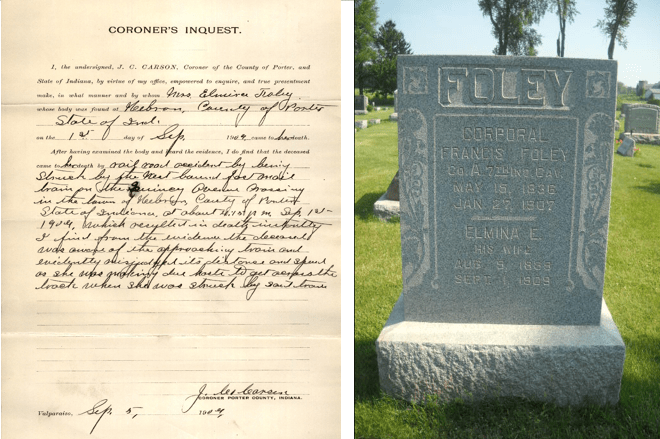
Tombstone Source: http://www.findagrave.com added by Andy Gappa.
“I find from the evidence the deceased was aware of the approaching train and evidently misjudged its distance and speed as she was making due haste to get across the track when she was struck by said train.” -Joseph C. Carson, Coroner, Porter County, Indiana.
The Porter County Clerk Archives continues to process countless records such as those of Hiram Tucker and Elmina Foley in relation to the railroad industry to help preserve those stories of yesteryear.
References: http://www.wikipedia.com; http://www.aflcio.org; Porter County Clerk Archives; http://www.genealogytrails.com; www. Wikipedia.com; http://www.quora.com; http://www.michigan.gov, Michigan’s Railroad History; http://www.brittanica.com; http://www.digital.lib.niu.edu/illinois/gildedage/pullman; http://www.crsreports.congress.gov; http://www.findagravve.com
 The Dash