Written by Victoria Vasquez | May 23, 2024
Blacksmith Shop Brawl Brings Bullets Blazing
The blasting sounds of gun shots disturbed the morning silence at the Trudell & Shaner’s blacksmith shop located in the small town of Chesterton, Indiana. On August 15, 1895, 2 men walked into a tension filled room. The shop owner, Mr. Shaner, could sense that trouble was brewing. William Tratebas was a young man between twenty and twenty-two years of age, and lived with his parents, who resided a mile south of Chesterton. William was a sensible and quiet young man to those who knew him. Alonzo Powers was older at the age of twenty-eight years old; he was a rough type and lived with his grandmother, Mrs. Ann Powers, who married his grandfather but was of no blood relation.
The shop owner watched carefully as words began to escalate between the men. Alonzo threatened the lives of young William and his brother Frank. Mr. Shaner called out to Tratebas and told him he better keep away from Powers since Alonzo seemed bent on quarreling with him. William, being a mild mannered young man said he was “not afraid of anything serious happening” and returned to the main room of the shop.
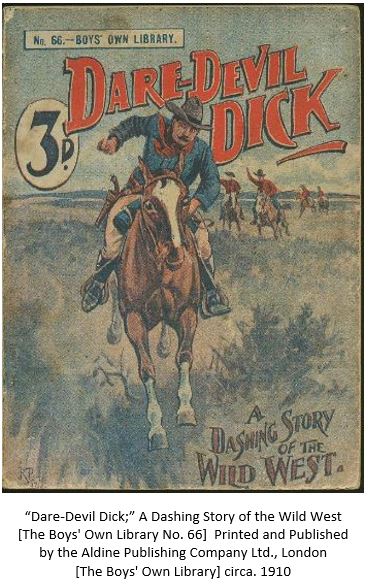
Alonzo was known to be an unsavory fellow. Since his childhood, his reputation was that of being lazy and shiftless with little ambition other than to envy his industrious neighbors. He lacked initiative blaming everyone else for his shortcomings by saying, “The world is against me. Everybody is down on me and won’t let me get up.” Instead of making a way for himself, he preferred to lay on the banks of a creek and fill his mind reading dime store novels or shooting turtles and marks as target practice. Many in the community felt that he would be quick to draw his gun on anyone like the characters in his novels. Powers had no boundaries and no one was off limits to his wrath, including his grandmother.
Weeks before the shop encounter, Powers had been “pounding on his grandmother” to the extent that he gave her a black eye. Ann sent for William’s father, Jerome Tratebas to come and help her, which he did. She told Jerome her story and he advised her to have Alonzo, also known as Lon, arrested to rid him from her life for good. However, she was reluctant to do it. Alonzo overheard their conversation while he waited in an adjacent room. Tratebas approached Powers and told him that “if he could not live with the old woman without pounding her, he ought to go away and leave her to peace.” Powers was not persuaded. Instead, he replied, “Well, give me two hundred dollars and I’ll get out.” Neither Jerome or the grandmother had any money to give him. Tratebas said that although he had been raised by the old woman, he was old enough to take care of himself and was entitled to nothing and ended the conversation.
Powers thought that the Tratebas men were out to get him. A few days before his run in with William at the shop, he overheard a conversation held between John, Will and Frank Tratebas at the door of the Powers’ house. The men had made a trip to the house where John’s wife was at to pause and stop outside the door for a short conversation. The men discussed the sale of a certain mill property to Crocker Land Company and had proposed a change in the dam which would increase the water power. Alonzo Powers was hiding behind a tree nearby and it’s presumed that he may have heard the word “Power” and imagined that he was the topic of their conversation. The next day, Powers jumped at Will, being the first of the trio that he saw and accused him of conspiring against him. William thought the accusation was ridiculous and treated the incident lightly, even though he was inclined to strike Powers, William refrained once he saw a revolver in Alonzo’s coat pocket.
It was on Thursday morning that Will Tratebas visited Trudell & Shaner’s blacksmith shop as customary to cross paths again with Powers. In spite of Mr. Shaner’s warnings to leave the premises before it was too late, William and Powers came together and clinched in a fight. Mr. Trudell separated the men with a strong warning that there would be no fighting in his shop. Seconds later, “Power stepped back a pace or two, put his hand to his right hip pocket, pulled a revolver, saying “You s—of a b—, I’ll end you,” and fired not once but twice” at young William.
“Both shots struck Tratebas full in the breast, in close proximity to the heart, and either shot would have proved fatal, and both made it sure. Tratebas, after being shot, took about four steps toward the rear door in the shop, uttered the words, “My God-,” fell to the floor and expired” as it was reported through witness testimony.
Shaner heard the shots and realized that it was Tratebas; he ran for Dr. Green, who immediately responded only to pronounce the victim dead upon his arrival.
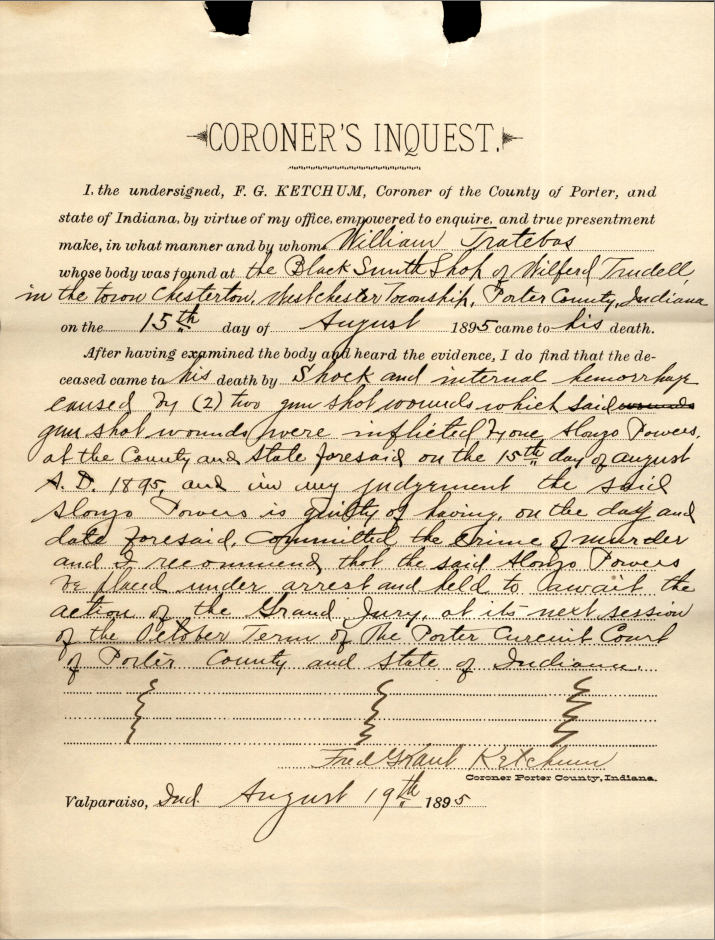
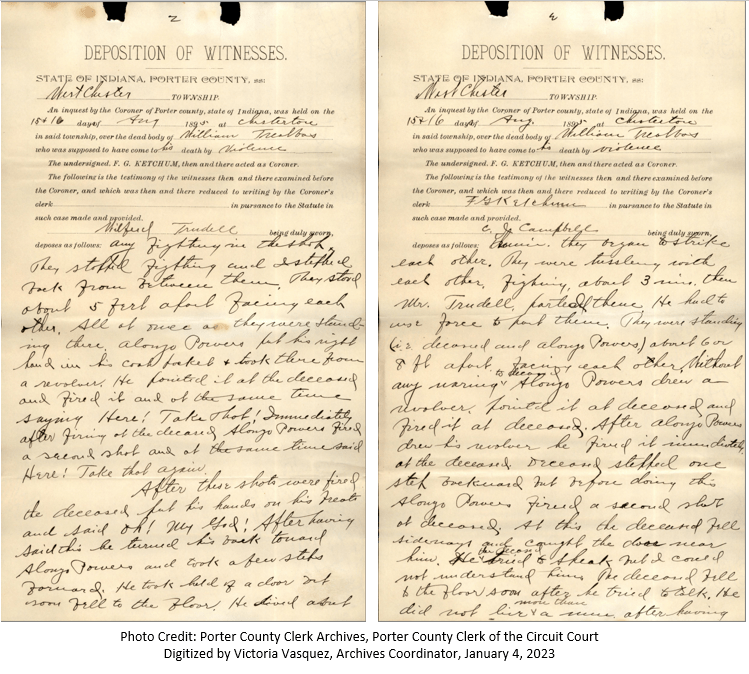
Fred Grant Ketchum, Porter County Coroner was immediately called to conduct a coroner’s inquest. He took the depositions of witnesses at the scene who gave their testimonies of the events that occurred. Those deposed were C.J. Campbell (Charles J. Campbell), A. L. Harper (Almer L. Harper), and blacksmith shop owners, Trudell and Shaner.
Photo Credit: Porter County Clerk Archives, Porter County Clerk of the Circuit Court by Victoria Vasquez, Archives Coordinator, January 4, 2023
Powers showed no remorse even though all the evidence was pointed at him for committing cold-blooded murder. He coolly walked away into his grandmother’s house and remained there until he was arrested by Deputy Sheriff Maxwell and Constable Brown. Powers barely escaped a lynch mob for his actions under the arrest and escort of Deputy Sheriff Green. Green transported Powers to Valparaiso amongst the rise of threats against him by an infuriated mob. Powers tried to hide his revolver in a hole in the ceiling but it was found by Constable Brown. Upon inspection of the murder weapon, an imitation Smith & Wesson 32 caliber, its five chambers had two rounds remaining indicating that Powers had fired three rounds at William. Powers gloated over his crime. He was insulting and tried to play the role of one of his dime story characters “Dare Devil Dick” in the presence of Justice Severs. Once word of William’s death reached the ears of his brother, Frank, revenge set in as Frank grabbed his loaded shot gun and headed towards the Powers house. Met by a mob, they tried to disarm Frank. John Coulter, Deputy Prosecuting Attorney rushed in and grabbed Frank while others struggled to have him let go of his shot gun.
There wasn’t a single reason that led to Power’s actions, but yet some reasoned it was a combination of incidents that caused Alonzo to take William’s life. Some speculated that it may have been that William stood up to Powers and defended his brother’s side of recent difficulties he had with Powers. In the end, Powers faced trial for the murder of William R. Tratebas. Knowing that he barely escaped the noose of his peers, Power’s attorney asked for a change of venue so Alonzo could stand trial in LaPorte County instead of Porter County . He was arraigned before Judge Hubbard with many witnesses for the state and only five for the defense.
Alonzo Powers plead not guilty to the charge brought against him. A venire of twenty-one jurors had been exhausted until twelve jurors were selected. Powers faced the death sentence or life in prison. Representing Powers was Judge Johnson and H. H. Loring of Valparaiso and E. E. Weir of LaPorte. Prosecuting Attorney Heard and Judge Crumpacker of Valparaiso and Attorney John Richter of LaPorte were seated at the State’s table present for the prosecution. Judge Johnston opened for the defense outlining a theory of self defense.
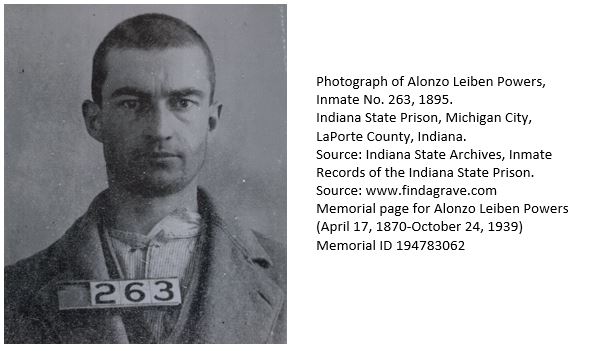
The jury was in session eight hours and fifteen minutes, excluding time allowed for supper. According to a juror the deliberations occurred as follows:
“Upon making ourselves acquainted with the surroundings in the jury room we took a ballot to ascertain if the man was guilty of murder. The result was unanimously yes. Next we endeavored to decide in what degree the prisoner was guilty. The result was eleven first degree, one third degree. Then the clash began. This one man was not in favor of hanging and it took two hours to convince him that it was not necessary to hang a man if found guilty of murder in the first degree. In the meantime other jurors, to prevent too hasty an action, jumped from their first vote and at one time there were as many as three votes for manslaughter in the third degree, which is punishable by imprisonment for not less than two nor more than twenty-one years. Gradually the jurymen drifted back to their first vote and it was decided by the twelve voters that the prisoner was guilty of murder in the first degree, which is punishable by death or imprisonment for life, being left to the discretion of the jury. In this case not one of the jurymen voted for the death penalty, which left but one alternative, that the prisoner should spend the remainder of his days in the state’s prison. [sic]”
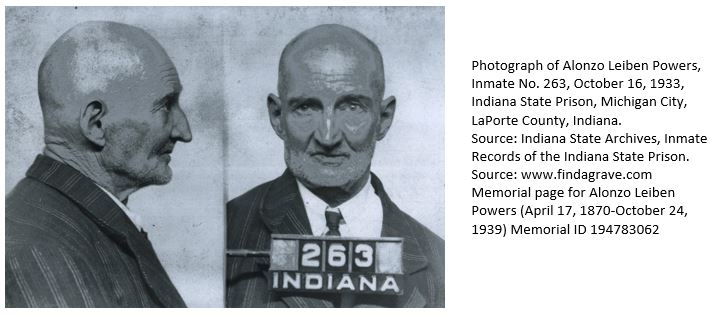
Alfonzo Leiben Powers was committed to the Indiana State Prison in Michigan City, Indiana on December 10, 1895. He drew prison number 263. On April 11, 1912, he was declared mentally unfit and was transferred to the insane hospital where he remained until his death. He served 44 years in prison until his passing at 72 years of age of cardio-vascular disease and cerebral arterio-sclerosis. Up to that point, more than 20,000 inmates were committed to the state prison. Upon his death, it was thought that he had a daughter but his remains went unclaimed. No family, if any, ever stepped up to identify him as their own. Instead, he was given a prison burial.
Justice was served for Young William R. Tratebas. May he continue to rest in peace.
William R. Tratebas is buried at the Chesterton Cemetery located at Chesterton, Porter County, Indiana.
Photo Credit: Eva & Hugh Hopkins, April 9, 2011; [Source: http://www.findagrave.com; Memorial Page for William R. Tratebas, Memorial ID 68139218.]

References: Porter County Clerk Archives, Coroner’s Inquest, filed with the Clerk of the Circuit Court on August 31, 1895, Porter County, Indiana [Recovered and Archived by Victoria Vasquez, Porter County Clerk Archives Coordinator, January 4, 2023, Portage, Indiana]
“A Terrible Affair” News article reporting the murder of William Tratebas published August 16, 1895, in the Chesterton Tribune, Chesterton, Porter County, Indiana [Volume 12, Number 19, Page 1, Columns 4-5]
“At Rest”
Death notice for William Tratebas published August 23, 1895, in the Chesterton Tribune, Chesterton, Porter County, Indiana [Volume 12, Number 20, Page 1, Columns 2-3].
“His Living Death”
News article reporting the trial of Alonzo Powers for the murder of William Tratebas published December 13, 1895, in the Chesterton Tribune, Chesterton, Porter County, Indiana [Volume 12, Number 35, Page 1, Column 4].
“Alonzo Powers On Trial”
News article reporting the trial of Alonzo Powers for the murder of William Tratebas published December 6, 1895, in the Chesterton Tribune, Chesterton, Porter County, Indiana [Volume 12, Number 34, Page 1, Columns 4-5].
“Alonzo Powers Dies After 44 Prison Years”
Death notice for Alonzo Powers published October 25, 1939, in The Vidette-Messenger, Valparaiso, Porter County, Indiana [Volume 13, Page 1, Column 6].
 The Dash