Written by Victoria Vasquez | January 28, 2025

Porter County Indian War Soldiers
Porter County had many volunteers rise to the call to serve in battle for our country. From the American Revolution to the present, thousands have sacrificed their lives for honor and duty. Some returned home while others did not. We may not know much about these brave soldiers, but we know they were once homesteaders, early settlers, farmers, business owners, and even young boys, who were barely men yet old enough to go to war. Let’s pay homage to our men who fought until the end.
To date, the United States has fought in 119 military conflicts notably in the American Revolutionary War, the War of 1812, the Mexican-American War, the American Civil War, the Spanish-American War, World War I, World War II and other conflicts. Other legendary Wars were the American Indian Wars (1609-1924), spanning 313 years of battle over land control. The conflicts involved Indigenous people, the English, French, Spanish and U.S. Army, which included several smaller battles between America and the native American tribes. The first conflict began in the 16th century with the Tiguex War (1540) fought in present-day New Mexico and ending with the Renegade period of the Apache Wars in 1924 fought in the Southwestern United States. The first conflicts began with the earliest Spanish settlements then battled through the Mexican-American War. The United States Army campaigns against the Apache began in the year of 1849.
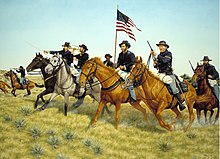
The Cherokee-American Wars (1776-1795) were fought in the Old Southwest. The United States formed regiments to enlist men for battle in territory between the frontier of the Mississippi and Ohio Rivers. The Apache Wars (1849-1886) were a series of armed conflicts between the United States and various Apache nations. Chief Cochise was leader of the Chokonen band of the Chiricahua Apache tribe.
Photo: Wikipedia.com
By 1885, soldiers who served in the United States Army for any war were required to enroll with their local Township Assessor’s office and have such enrollment recorded with the Porter County Clerk of the Circuit Court pursuant to Indiana law. The Porter County Clerk Archives has preserved what remains of these records along with other details about the men and their military service.
On April 13, 1885 the Indiana General Assembly passed “An Act to enroll the late soldiers, their widows and orphans, of the late armies of the United States, residing in the State of Indiana.” Many of our soldiers returned home and complied with this action. However, those who were deceased had their surviving spouse, and children recorded instead. Some soldier details that were recorded included but not limited to a soldier’s rank, company, regiment, state mustered from, the name of the war they fought in and if they were injured during their line of service.
We pause to remember-
Andrew Games
Rank: Private
Company H
21st Regiment of Infantry
Washington Township
Also served in the Civil War.
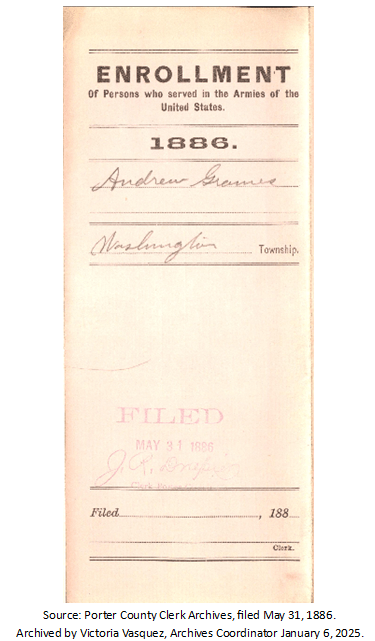
Private Andrew Games returned to Washington Township, Porter County, Indiana after serving in Arizona during the Apache Wars, which took place between 1846-1886. Settlers from Mexico and the former American colonies staked homes farther into the lands of the native people, which posed an invasion of the occupied lands. The conflict escalated while the United States fought to take control of the territory.
The Apache Wars lasted 25 years with the last major battle ending in 1886 when Geronimo, one of the most notable Apache warriors of the time, surrendered to the United States. In 1871, Congress ended formal treaty-making with Indians after nearly 100 years of diplomacy. Congress agreed to honor approximately 368 Indian treaties that had been ratified from 1778-1868 stating that “henceforth, no Indian nation or tribe […] shall be acknowledged or recognized as an independent nation, tribe or power with whom the United States may contract by treaty […]”
Some didn’t have to travel far with the Northwest Indian War (1785-1793) nearby in action. The Battle of Fallen Timbers was between the United States and the Chickasaw and Choctaw tribes. The American occupation of the Northwest Territory began the European settlement of what is known today as the Northwest Indiana region, including Porter County. Tecumseh’s War (1810-1813) and the War of 1812 occurred in the Northwest Territory, also known as the “Old Northwest” and formally known as the “Territory Northwest of the River Ohio,” which was formed from unorganized western territory in the United States after the Revolutionary War. The Battle of Tippecanoe was fought on November 7, 1811 in Battle Ground, Indiana between American soldiers of the Indiana Territory against the Shawnee tribal leader Tecumseh and other tribes who were against the European-American settlement of the American frontier.
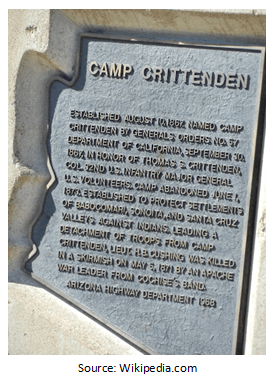
Private Games fought further away from home. He was initially enlisted with the 32nd Regiment of Regulars, which was consolidated later with the 21st Regiment. His infantry fought in the Indian Wars in the Southwestern territories. He was stationed at Camp Crittenden in Arizona and injured by the end of his service. Camp Crittenden was a U.S. Army post established on August 10, 1867, at the head of Davidson Canyon, three miles west of present-day Sonoita, Arizona. The fort was named for Colonel Thomas L. Crittenden, who commanded the 32nd Infantry at the battles of Shiloh, Stone River, and Chickamauga during the Civil War. The fort saw much action during the Apache Wars, heaviest between 1870-1871. The camp was finally closed on June 1, 1873.
War of 1812 and The Mexican-American War
War did not discriminate. The War of 1812 began on June 18, 1812 when the United States declared war against Great Britain. The Indiana Territory played a central role in the war that lasted between 1812-1815. It’s first battle was fought on Indiana soil.
We pause to remember-
Elisha Atkins
Rank: Private
Company: Captain C. Ives and Captain D. T. Welch’s Company
37th Infantry
Pleasant Township
Isaac Cornell
Rank: Private
Company: 135th Regiment (Christy’s) Pennsylvania Militia
Boone Township
Eliphalet David Curtis
Rank: Private
Company: 1st Regiment (Bloom’s) New York Militia
Union Township
The Mexican-American War, began on April 25, 1846 with a rival attack on U.S. soldiers and the siege of Fort Texas along the Rio Grande. During the conflict, Indiana provided five infantry regiments, including three companies from the Indianapolis area. The first unit from Marion County was Company H, 1st Indiana Volunteer Infantry, organized June 4, 1846. This element was stationed near the mouth of the Rio Grande River for the entire war.
We pause to remember-
Andrew Smith
Rank: Private
Company L
1st Regiment
Michigan Infantry
Washington Township
Also served in the Civil War
Source: Mexican-American War, HistoryMaps.com

Civil War Union Soldiers
More than 200,000 Hoosier men served in the military during the Civil War (1861-1865). When President Abraham Lincoln called for 75,000 soldiers to stop the rebellion, Indiana did not make haste to provide its required 7,500 volunteers. In the end, Indiana had 24,000 deaths.
Porter County did not hesitate to gather its men to volunteer. When the first shot against the granite walls of Fort Sumpter was fired, thousands of men all over the North united against the rebellion. Porter County was no exception. She “showed her loyalty, shouldered the musket and unsheathed the sabre for the defense of the Union. Her soldiers went among the first and remained “until the last red blade was broken, and the last arrow in the quiver.”
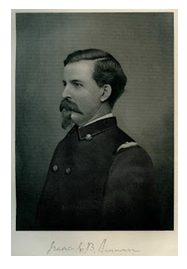
Isaac C. B. Suman, served as a Colonel in the war. It’s reported that he was the second individual in Porter County to enlist for service. He began as a private and served in Company H of the 9th Indiana Volunteer Infantry. He was soon elected to serve as the company’s first lieutenant to later be promoted to Lieutenant Colonel. On April 17, 1863 he became Colonel of the 9th Indiana Volunteer Infantry and held his position of leadership through the end of the war.
Source: Engraving of Isaac C. B. Suman by Lewis Publishing Company’s History of Porter County, Indiana 1912
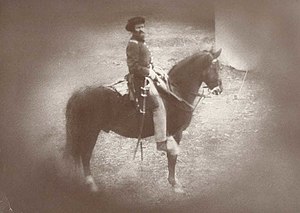
Soldiers on horseback played a huge role during the Civil War (1861-1865) and the Spanish-American War (1898). Many Porter County men served in the United States Cavalry and were mustered out from different states of the nation. The most famous of units were the “Rough Riders” whose nickname was meant for the 1st United States Volunteer Cavalry. They were 1 of 3 regiments raised in 1898 for the Spanish-American War. It included 1,060 cavalry soldiers with 1,258 horses.
During the Civil War, the 1st Indiana Cavalry Regiment, also known as the 28th Regiment of Volunteers, was a cavalry unit that served in the Union Army. It was organized in Evansville, Indiana and mustered on August 20, 1861. It did most of its fighting in the State of Arkansas and then discharged in June of 1865. The Regiment lost during service 4 Officers and 32 Enlisted men killed and mortally wounded and 3 Officers and 148 Enlisted men by disease for a total of 187 soldiers overall. The 2nd Indiana Cavalry Regiment, also known as the 41st Regiment of Volunteers, was the first complete cavalry regiment raised in the United States, State of Indiana to fight in the American Civil War.
Today, the hard-riding spirit of the United States Cavalry is alive and well in the 1st Cavalry Division. More than 24,000 Soldiers serve in the combat-ready division.
Photo of Captain Mathew Simpson Clegg of Company M, 5th Indiana Cavalry Regiment
Source: Wikipedia
We pause to remember-
Winfield Pierce
Rank: Private
Company C
7th Regiment, Indiana Cavalry
Pleasant Township
John Hall
Rank: Corporal
Company G
9th Regiment, Illinois Cavalry
Pleasant Township
Short Term Soldiers
Some volunteer soldiers had a shorter service during the war lasting only 3 months of time. These soldiers usually had orders to protect the railroad system or a fort, or may have had a special assignment. The 55th Regiment, Indiana Infantry was organized June 16, 1862 at Indianapolis, Indiana for 3 months. Part of its duty was to guard prisoners through the month August. It also served in the Battle of Richmond, Kentucky on August 30th. The soldiers were mostly captured, then paroled and sent to Indianapolis, Indiana. The regiment mustered out September 6 and served until October 23, 1862.
We pause to remember-
Thomas J. Clevenger
Rank: Private
Company F
55th Regiment, Indiana Infantry
Liberty Township
Musicians in the War
The war had many different soldiers serving their country. One special type were the Musician soldiers. These soldiers marked the activities of everyday operations of the war, including wake-up, lights-out, roll call, and drills. The music that these soldiers provided helped organize the movement of troops, such as in marching, and often transmitted musical combat orders to soldiers, who were trained to recognize these encrypted commands.
Field musicians provided essential duties for the daily army life both in camp and out on the battlefield. The Musicians played a huge role in popularizing songs during the Civil War that are now well commonly known. Music provided a backdrop to help lift the spirits of the soldiers in battle as they faced the challenges of serving in the war. The soldiers played instruments such as fifes, drums, and bugles.
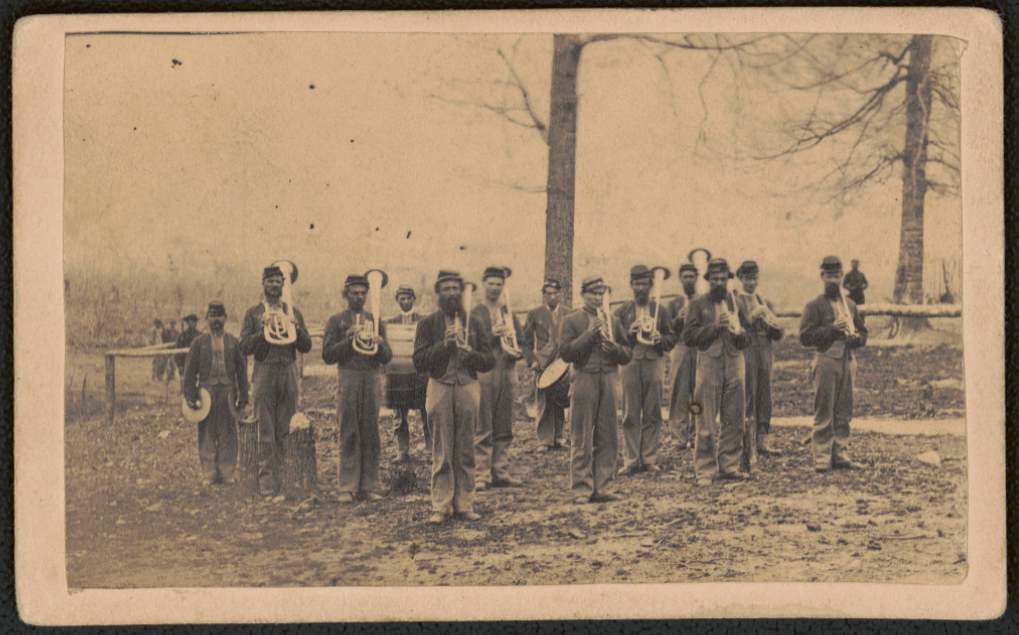
It’s been estimated that more than 54,000 military musicians served in the Civil War between the Union and Confederate armies. The songs played were made popular by the musician soldiers as they played these songs into the battlefield. The regiments would play and sing the songs in their camps that would quickly spread into the nearby communities that heard these musical tunes. Probably the most familiar tune to date is “Taps” which first emerged in 1862.
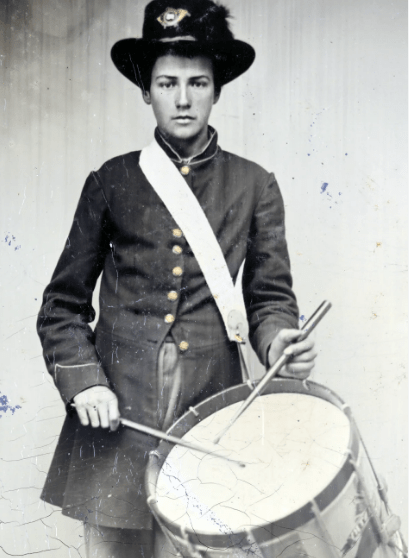
This solemn tune was played at military funerals and to end the day at U.S. Army bases. It was first created when a Union general worked with his brigade’s bugler to try out a new bugle call for the call of lights-out. It was played at a military funeral the first time during a Peninsular Campaign in Virginia later that year. Some other popularized songs from both sides of the camp were “The Battle Cry of Freedom and “We Are Coming, Father Abraham” on the North side, and “Dixie” and “Bonnie Blue Flag” on the South side. The most notable song by both sides was “When Johnny Comes Marching Home,” which U.S. Troops would carry on to sing during World War I and World War II.
Photo: Drummer Boy, Civil War; Library of Congress
We pause to remember-
Samuel Gordon
Rank: Musician
Company A
73rd Regiment, Indiana Infantry
Washington Township
The Irregular Soldiers
The Irregular Military, were armed forces that carried out irregular or unconventional warfare tactics during the war. This included sabotage, direct raids, ambushes, and special reconnaissance missions. These were especially dangerous maneuvers that men risked their lives beyond the call of duty.
We pause to remember-
John Zoss
Rank: Private
Company A
51st Regiment, Indiana Infantry
Liberty Township
Lafayette Harris
Rank: Private
Company B
151st Regiment, Indiana Infantry
Liberty Township
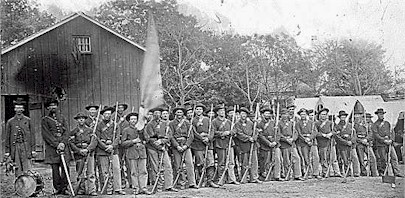
In the end, Indiana furnished 208,365 soldiers during the rebellion, divided into 175,776 infantries, 21,605 cavalries, and 10,986 artilleries. Indiana soldiers participated in 308 battles throughout 17 different states.
“We don’t know them all, but we owe them all.”
References: Porter County Clerk Archives, Portage, Indiana; http://www.wikipedia.com; the Circle News, Article by Michael Meuers, thecirclenews.org; http://www.connerprairie.org; http://www.history.com; http://www.explorethearchive.com; http://www.legendsofamerica.com; http://www.wisevoter.com; http://www.porterhistory.org; http://www.kennedy-center.org; http://www.battlefields.org; http://www.history.com; http://www.army.mil; http://www.wikipedia.com; Dyer, Frederick H. (1908). A Compendium of the War of the Rebellion: 1st Indiana Cavalry. Des Moines, Iowa: Dyer Publishing Co.; http://www.visitindiana.com; http://www.inportercounty.org; http://www.familysearch.com; http://www.crsreports.congress.gov; http://www.battlefields.org.
 The Dash