Written by Victoria Vasquez | March 27, 2025

The Clerk Archives Department continues to preserve their vast record collections daily to help bring history to life. With a multitude of court records to explore, the collaborative work between staff and community volunteers is remarkable. Together, they uncover past events that occurred in Porter County. The stories discovered from these records are worthy to share. The details are brief. Still, they hold a wealth of information for those interested in the people, places, and things of Porter County. We hope this glimpse back in time is beneficial to families and researchers alike for years to come.
TRAINS & RAILROADS
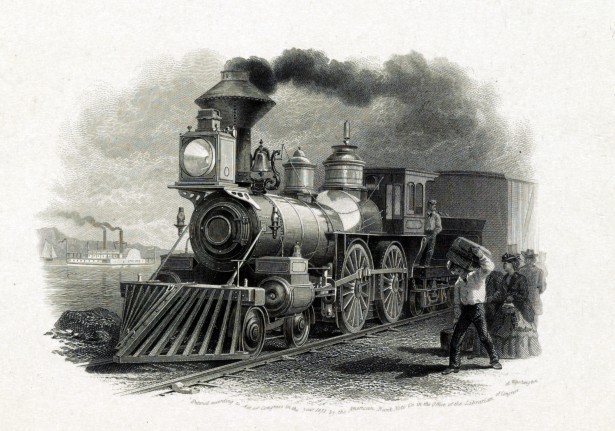
Pictured: American West Old Steam Train, 1873
Source: History of Steam Locomotives, Railroad Society
William & Edith Sabinske – November 25, 1898
S.S. & M.S. RR killed 2 men and injured 2 girls; 6 passengers in hand car struck on tracks in Westchester, Indiana. Killed by special mail train No. 44.
John Wiltonba – April 20, 1904
An unknown white man presumed to be John Wiltonba at approximately 35 years old came to Portage Township, Indiana on Monday, April 18, 1904 seeking employment. He met with John Lahayn, who resided on McCool in Portage Township and asked for work. Mr. Lahayn said he could oblige if John could find a place to board and lodge. Mr. Lahayn expected that John would return in the morning to go to work. Knowing employment was within reach, John sought a place to stay overnight and sought shelter so he could begin working for Mr. Lahayn.
He next came across Charles W. Lockwood, who was a railroad operator, on the evening of April 18th. John was told he could stop for the night in the Tower house. John told Lockwood that he had employment waiting for him if he could find a place to lodge and board. Lockwood obliged by allowing John to stay on the premises. John accepted the offer and rested for the night.
John M. Fennery also a resident of McCool station noted how John came into the store on Monday evening. He came back the next day and in conversation told Fennery that he found employment but was afraid that he would have to give it up and go tramping again because he could not find a boarding place. He remained in the store until a little after 8 o’clock in the evening on Tuesday, April 19th and then left back to the Tower house. John seemed satisfied with his temporary boarding arrangements and the work that waited for him ahead.
After returning to the Tower house, John ventured back out a little after 8 o’clock PM and took a pail with him to get some water. Two days had passed since Mr. Lahayn spoke with John and there had been no return of him to work. Mr. Lahayn later heard that a man was killed on the rail road and discovered it was the same man. Mr. Fennery was the last time he was seen alive. Two days had passed from the time John came to Portage Township. He knew no one in the area nor was anyone familiar with him. On the morning of Wednesday, April 20th, he was found lying north of the Baltimore & Ohio Railroad tracks under the Milk shed with his head severed from his body.
MILITARY SERVICE
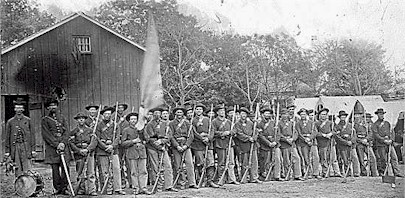
Pictured: The 44th Indiana Infantry Regiment.
Source: Wikipedia.com
Cornelius P. Curtis – April 6, 1893
It was attested by witness, Joseph Barnes that Cornelius was a former soldier of the war prior to his death in April, 1893. For 2 years, he worked as a farm hand for George Weddell. He was killed by the Pittsburgh, Fort Wayne & Chicago Railway train.
William Robert Warren – March 21, 1885
William was thought to be a soldier from the Civil War by his community. He came to his death by extreme exposure of the brutal cold weather and suffered acute congestion of the lungs.
Thomas C. Powers – February 17, 1903
Deposition testimonies affirm that Thomas C. Powers was a soldier, who had been receiving his soldier’s pension. He had once lived in the “Soldier’s Home” being an “old soldier” of the Civil War since the Soldier’s Home was created in 1865 by the Indiana Governor to provide shelter for soldiers who served in the Civil War. Powers could no longer stay there since according to the witness testimony made by John Fergeson, a resident of Valparaiso, who knew Powers well, that he had to leave the home because “they did not keep Old Soldiers who had more than twelve-hundred (1200) dollars; I took it for granted from what he said that he was worth that amount.” Thomas Powers was living in a run-down room at 31 E. Elm St. Valparaiso, Indiana; “the room was cold, dirty and terribly open” and Fergeson believed that it was due to the exposure and lack of nourishment that Powers was experiencing to have caused his death. Fergeson was arranging to take Powers to his home to live with him but learned of his death before that could happen. Powers had a roll of five-dollar bills and $10 gold coins on his body and in his bed that totaled $520 when he was found. The money was given to Coroner Carson. Power’s military service details state that he was a soldier with the 26th Independent Battery Indiana Light Artillery, Company A, 17th Indiana Infantry.
John W. Elam – November 15, 1910
Captain John W. Elam entered the Union Army with a starting rank of First Sergeant for the Civil War and ending with a rank of Captain. He served with the 87th Regiment Indiana Infantry. He enlisted on July 31, 1862. Captain Elam went on the become a postal mail clerk appointed in 1876 to then become elected in 1886 as the Porter County Auditor on the Republican Ticket. He died on November 15, 1910 from a cerebral hemorrhage and the hardening of his arteries due to his advanced age.
CHURCHES & CLERGY
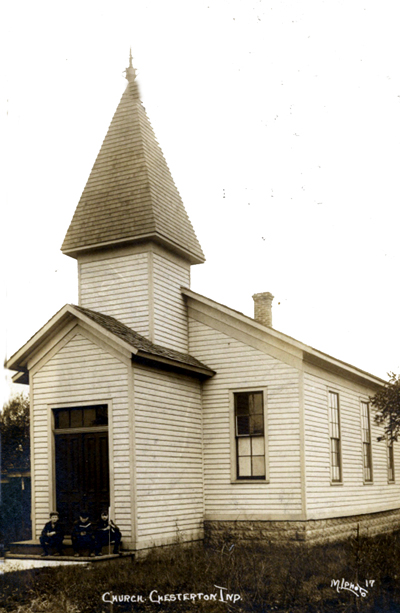
Pictured: Old Church in Chesterton, Indiana
Source: Northwest Indiana Genealogical Society
Asahel Neal – October 8, 1836
George W. Turner, Porter County Circuit Court Clerk, recorded the first account of church business for the newly established county in the State of Indiana as one of his first duties as a newly elected official. On June 16, 1828, a gathering of clergymen came together to hold the ordination of Brother Asahel Neal as a Minister of the Gospel. This event was the first “presbytery” recorded in Porter County by the Clerk’s office on October 8, 1836. Those present were a “number of brethren being legally called together by the Baptist Church of Christ.” Leading the divine ceremony was Elder John Lee, with John Henry, Thomas Gardner, and James Braman, who represented other churches from throughout the area. The men proceeded to ordain Brother Asahel Neal “by the laying of the hands in the name of the Holy Trinity in solemn prayer to Almighty God.” Brother Neal went on to perform many wedding nuptials for the early settlers. The first marriage ceremony that he officiated was between George R. Williams of Elkhart County and Rhoda Hathaway of Porter County on July 23, 1836. His next service was held for Robert Fleming and Margaret Ann Saylor, both of Porter County, who tied the knot on November 30, 1836.
Hawley Baxter Beer – December 27, 1837
Hawley Baxter Beers, a Methodist Episcopal minister, was born at Cold Spring Harbor, L. I., April 23, 1810. He was powerfully converted in 1831, and in 1836 entered the itinerant ranks of the Indiana Conference. When that conference was divided-he became a member of the North Indiana Conference. Reverend Beers’ first record of solemnizing a marriage was during the Christmas season of 1837. He performed the wedding ceremony of Russel Dorr and Emeline James on December 27, 1837. Reverend Beers settled in matrimony himself when he married Lucy M. Taylor on April 6, 1843. In 1866 Beers’ failing health declined until his death on May 7, 1873.
MISCELLANEOUS TOPICS
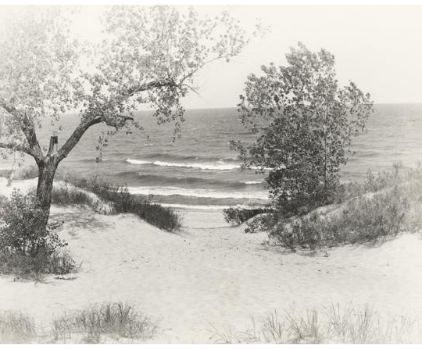
Pictured: Indiana Dunes National Lakeshore, circa 1923
Source: Chicago Historical Society (ICHi-37450)
George Burr – October 26, 1879
George’s body was found floating along the lakeshore in Portage Township; he died by drowning after falling from a hot air balloon that was on a trip. The deceased was thought to be about 32 years of age and presumed to be the man who went up in the balloon with Professor Wise whose departure was from St. Louis on September 18, 1879.
Otto Herman Johnson – February 1, 1902
Otto was a nightwatchman for Marshall Field & Company and lived in Chicago. He was found washed up on the shores of Chesterton in Mid-April after he had been missing for 2 months. It is believed that in February he was with 3 other men in Chicago who went missing; they were either hunting or fishing out on Lake Michigan when their boat was swamped and all hands were lost; the other 3 men were recovered but Johnson’s body had not been recovered at that time.
William A. Seymor or Seymour – January 3, 1902
William was a watchman for the Pennsylvania railway. He lost his position and was despondent over the loss that he committed suicide on Friday, January 3, 1902. William served in Company 3 of the 157th Indiana Volunteer Infantry during the Spanish American War. Rank unknown. The Company consisted of 50 officers and 972 enlisted men. The regiment was commanded by Colonel George Studebaker.
Nancy Neff – June 20, 1903
Ms. Neff passed away from bowel issues or appendicitis. She gave her estate away, which was valued at $10,000 to the Baptist Church and cut off the rest of her family from her estate. At the time of her death, she was a Dowieite, which was initially of the Christian Catholic Apostolic Church in Zion, a religious organization chiefly centered in Zion City near Chicago, Illinois. It was originally formed in 1896 by John Alexander Dowie, to which it’s name is derived from for its followers. The Dowietes faith-seekers embraced the practice of their devotion to living a religious communal life, faith healing, and abstinence. She left the Baptist Church a benevolence gift of $5,000 but the pastor sued for the entire estate.
Frank Dolata – February 4, 1926
Mr. Dolata was crushed during a cave in of a sand pit while loading sand near Chesterton, Westchester Township. It was a bizarre occurrence and shocked the community while bringing awareness to the hazards of this type of occupation.
Robert Bartholomew – February 19, 1926
Firefighter Bartholomew perished in the line of duty. His death was deemed accidental since he was killed by a falling brick wall while fighting a fire at the Kaufman store in Valparaiso. The floor collapsed and he fell to the basement along with 5 other men.
William Klemmeck – December 26, 1933 est.
It was determined that Mr. Klemmeck had died from accidental drowning while fishing in Lake Michigan. His body was discovered on the shores of Lake Michigan east of the Prairie Club about 500 feet in the state park. The body was in bad condition when found lying face down on the beach with a large belt around his body. It was estimated the body was in the lake all winter long. His description depicted being a large man, who might have been a policeman according to Johnson Brothers’ witness testimony. The peculiar part is the deceased was thought to have drowned in December of 1933, when he may have been reported missing, but was discovered at 8:30 in the morning on April 8, 1935 in Westchester Township, Porter County, Indiana.
 The Dash