Written by Victoria Vasquez | March 9, 2026

The first women to settle in Porter County were remarkable in their own rights. The most prominent female figures were those of the Bailly family, who arrived in the region in the early 1830’s. Marie LeFevre Bailly was the matriarch of the homestead. She was of métis (mixed European and Indigenous) heritage and managed the estate. Her daughters, Rose, Frances, and Hortense Bailly were also very active within the community. Many early settlers arrived in the area between 1833-1834. Jane Spurlock was the first bride to have nuptials in the county. Her father Cyrus Spurlock was a Methodist minister who performed the ceremony on May 5, 1836. Elizabeth Bundy’s specific marriage to Edward Dorr soon followed. The Bundy family, including Juliann and Susannah, were among the earliest settlers in the mid-1830s. That same year, Sophia Dye became the first teacher in Liberty Township. She taught a subscription school in a log house in the Zane settlement, earning two dollars a week. Agnes C. Cornell (Axe) arrived next with her husband, Jacob Axe, after an 18-day journey from Ohio. Anna Dillingham Lyons came later that year. She was part of the foundational settlement wave. As news spread of the prospering settlements in the Northwest Territory more families arrived to start new lives. Men ventured to explore the opportunities bringing in tow their wives and children. Many of these women had paved the way for others like them but the hands of time would turn slowly.
As villages and settlements flourished, maintaining a civil society was inevitable. Several men of the spanning communities gathered to plan for their future. On January 28, 1836, the territory became officially organized and Porter County government was established. During its formative years, the first elected county officials were chosen in an election held on February 23, 1836. The first Porter County elected offices were Sheriff, three County Commissioners, County Clerk, County Recorder, and County Treasurer. There was also a Probate Judge and two Associate Judges.
During those first ninety years, those positions were held by prominent men from the community. The first County Clerk was George W. Turner. His official act of duty occurred when he issued the first marriage license to Richard Henthorne and Jane Spurlock. Turner entered the practice of law around 1845. He continued in the profession until he left the county in 1856. By the early 1900’s, several upright citizens served as County Clerk including Rufus P. Wells, James R. Drapier, Gustaf E. Bornholt and Roscoe C. “Ross” Jones.
For most of America’s history, women did not have the right to vote in the United States. The 19th Amendment was formally added to the U.S. Constitution with its ratification on August 18, 1920. Before this amendment, the U.S. Constitution did not guarantee a woman’s right to vote, leaving it to individual states to decide. Its passing was a landmark victory for women across the nation. Indiana became the 26th state to ratify the 19th Amendment during a special legislative session. On November 2, 1920, more than 500,000 Indiana women voted in the general election. Anna D. Monroe of Indianapolis is credited as the first woman in the state to cast her ballot that day. By the winter of 1926, the political landscape changed in Porter County.
Mae Rachel Arnold was the fifth child of Edward and Clara (Dawson) Arnold. She was born on April 29, 1884 in Kendallville, Indiana. Mae had four older brothers, Edward, Nathan, George and Frank. She went to high school at Kendallville and continued her education in 1909 at the University of Valparaiso. On June 12, 1904, she married William M. London, the son of Lycurgus and Nana (Dawson) London of Franklin, Kentucky. Mae worked as a bookkeeper for the Associated Physicians from 1915-1916. She then entered the government sector serving as a deputy auditor for the county Auditor’s office from 1918-1919. Mae left the auditor’s office after gaining employment with Clerk Roscoe Jones in 1920. She remained a deputy clerk for the next few years under his direction. On January 20, 1926, Mae announced some ground breaking news. She would be a candidate on the Republican ticket to succeed Jones. London won the Primary Election nomination on May 4, 1926.
Mae London made history during the general election. She became the first woman elected to a public office in Porter County, Indiana. She won the County Clerk’s race on November 23, 1926. She defeated E. M. Passow, Democrat candidate and William J. Upp, Independent candidate, each being two men of recognized political influence. London served for one term ending in 1930. At the time, London had been the only woman practicing law in Porter County. She also served as the secretary of the Porter County Bar Association. London ran for re-election in 1930 but was defeated by the Democrat Candidate Joseph L. Doyle by a margin of 62 votes.
In early 1942, Mae entered her second marriage to Ora L. Wildermuth. Ora’s earlier life had its challenges. Although his primary education began in Pulaski County, Indiana, he traveled to Star City for high school. By his fourth year he was the only high school student enrolled. The school trustee refused to hire a teacher for one student so he completed his secondary education in Winamac. In 1906, he earned his Bachelor of Laws (LL.B.) law degree, being one of six students from Indiana University Law School. He was admitted to the bar and in August 1906 moved to Gary, Indiana, a new town booming with opportunity. At first, he laid concrete for the first blast furnace at a new local mill that was under construction. As families began to arrive to the new town, he realized the city didn’t have a school. A school trustee board of three men were chosen and Ora was named the first school teacher. He taught at a school house located at 4th avenue on the westside of Broadway in Gary. The school’s capacity allowed for 36 students. Word spread quickly of the new school. It was often jammed with students. Books were a hot commodity and since they had none, enough money was raised to purchase 75 books. During winter, tramps would break into the schoolhouse and use the books for fuel to keep warm. This became an issue for Ora. While working as a teacher, he began to establish his law practice. His first law office was a tar-paper covered shack, where he also lived in. To protect the books, they were moved from the schoolhouse to his office. In a few months, Ora became Gary’s first resident lawyer. He was also the first schoolteacher and first librarian. Moreover, he became the first president of the Gary Bar Association. Ora Wildermuth, a Democrat, then took office as the first city judge of Gary, Indiana, in 1910. He served as judge from 1910 until 1914.
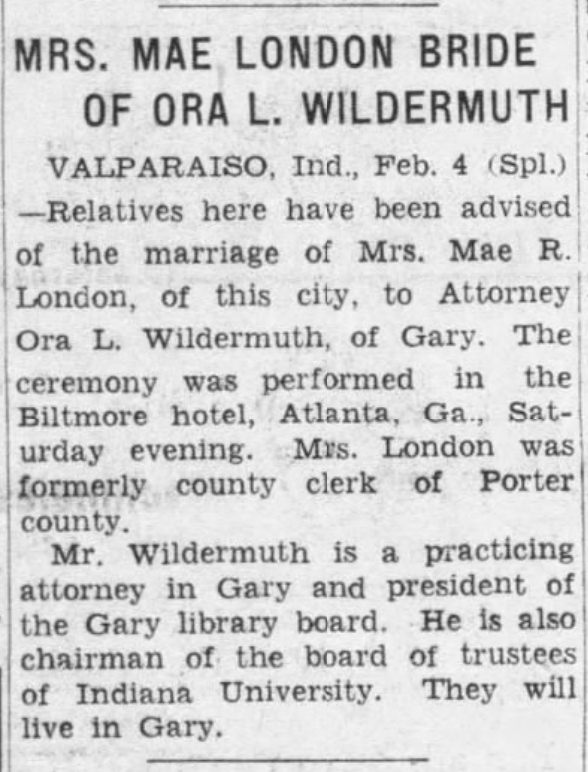
On April 23, 1941, Ora became a widower from his marriage to Cordelia Wilds. The next year he married Mae R. Arnold London, former Porter County Clerk. Their wedding took place at the Baltimore Hotel in Atlanta, Georgia in 1942. They returned to Gary to live. Their marriage lasted ten years before a life altering event occurred.
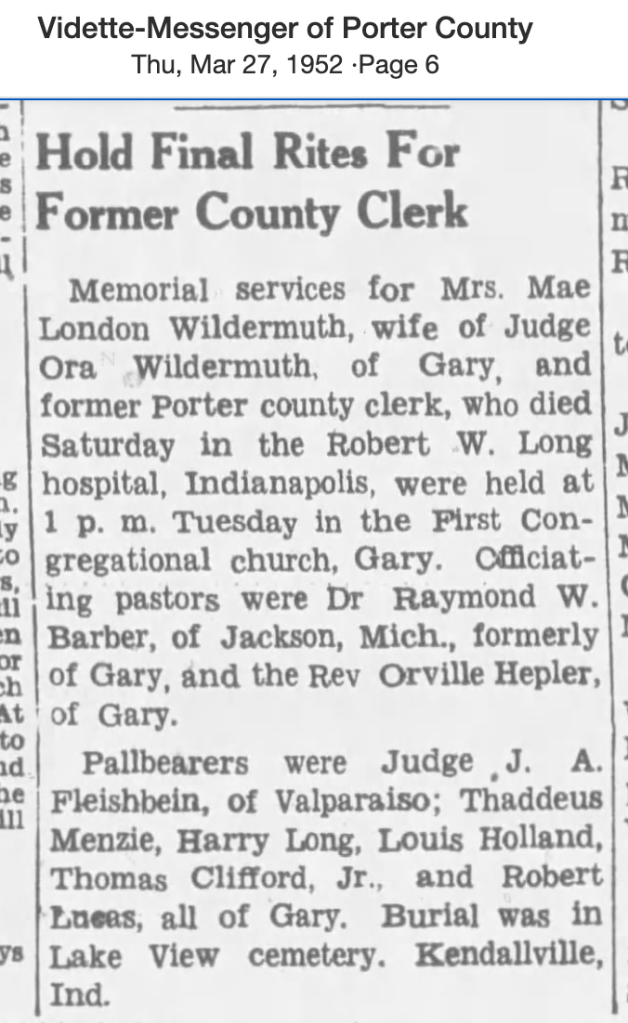
Mae’s health began to decline in October of 1951. She struggled with her extended illness for nearly six months. Mae London Wildermuth passed away at the age of 67 years old at the Robert W. Long hospital on March 22, 1952 located in Indianapolis, Indiana. Memorial services were held at the First Congregational Church on Grant Street in Gary, Indiana. One of her pallbearers included Porter County Circuit Court Judge J. A. Fleishbein of Valparaiso. Mae is laid to rest at Lake View Cemetery in Kendallville, Noble County, Indiana.
Mae London Wildermuth broke glass ceilings during a time when women refused to be silenced. She helped pave the way for future generations of Porter County women leaders. Resilience at its best.
Reference: History of Porter County Indiana, https://www.inportercounty.org/Data/Misc/PorterCountyHistory-1876.html; Women’s Suffrage in Indiana, Looking Backward, https://hcpl.lib.in.us/wp-content/uploads/2021/04/; The Vidette-Messenger-Porter County, http://www.pocomuse.org; Mae R. London, Biography, http://www.inportercounty.org; Cannon, Thomas H., H. H. Loring, and Charles J. Robb. 1927. History of the Lake and Calumet Region of Indiana Embracing the Counties of Lake, Porter and Laporte. Volume II. Indianapolis, Indiana: Historians’ Association, page 827; The Indianapolis News Wed, Feb 04, 1942; Page 16; Mae Rachel Arnold Wildermuth, http://www.findagrave.com; Vidette-Messenger of Porter County, Thursday, March 27, 1952, Page 6; The Herald-Times, Mon, Mar 24, 1952, Page 11; Ora Wildermuth, Lake County Indiana Biography by Dorothy Wildermuth Vekasi, http://files.usgwarchives.net/in/lake/bios/wildmt-o.txt accessed 03/06/2026
 The Dash