By Cheryl Wilcox | October 2, 2026
Grommets, Ribbons, and Pretty Pins
Here at the Porter County Clerk Archives, the archives staff processes historical documents dating back to 1836, when the county was first established. Preparing the older court records for indexing and digitization takes patience as clerks face tiny challenges that come in all shapes and sizes. During any given day, it’s fascinating to see the clever ways that documents were held together.
Before there were paper clips and staplers, keeping a stack of documents together required a little more creativity. Clerks and attorneys in the 1830’s might have reached for a ribbon, thread, pin, sealing wax or wafer to bind documents together when filed with the County Clerk’s office. By the end of the 19th century, they had an impressive selection of new gadgets to assist in this process ranging from brass fasteners, grommets, staples and paper clips. By the 20th century, the convenience of transparent tape, binder clips and a seemingly endless variety of office fasteners became available.
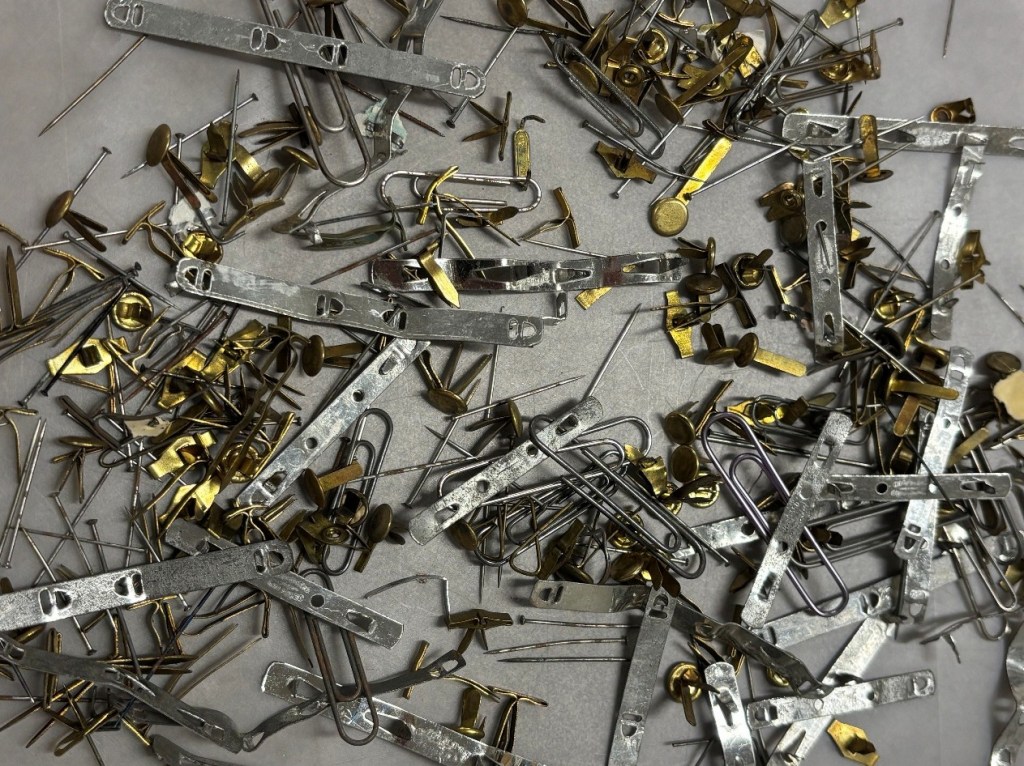
As we take a look back on how these dynamo gadgets and gizmos worked, it became quite fascinating how important it was to keep court records tidy and secure.
Document Fasteners: 1830 to Today
| Fastener | Approx. period of use | What was happening |
| Ribbon / tape | Before 1830–present | Used to tie bundles and lace official documents |
| Thread / string | Before 1830–present | Documents could be sewn or tied together |
| Straight pins | Before 1830–late 1800s | Simple temporary fastening; later specialized “bank pins” |
| Sealing wax | Centuries before 1830–1800s | Security/authentication as well as fastening |
| Wafers / adhesive seals | 1600s–1800s | Starch-based adhesive discs used to join/seal papers |
| Glue / paste | At least mid-1800s | Used to attach paper strips and sheets |
| Grommets / eyelets | Mid-1800s onward | Permanent fastening through punched holes |
| Brass fasteners / brads | 1866 onward | McGill’s invention becomes major office fastener |
| Staples / staplers | 1860s–1870s onward | Mechanical stapling develops rapidly |
| Wire paper clips | 1867 patent; widespread by 1890s | Removable, non-perforating fastening |
| Rubber bands | Mid/late 1800s | Temporary bundling |
| Red tape / office tape | 1800s | Literally ribbon/tape used to bundle government paperwork |
| Binder/bulldog clips | Late 1800s/early 1900s | Reusable clamping without piercing |
| Adhesive tape | 1920s onward | Pressure-sensitive tapes become practical |
| Transparent/cellulose tape | 1930 onward | 3M develops cellulose version |
| Plastic-coated clips/fasteners | 20th century | Increasing variety and corrosion resistance |
| Modern archival fasteners | Late 20th–21st c. | Stainless steel clips, archival ties, polyester, vinyl etc. |
Ribbon, String and Thread — The Original Document Fasteners
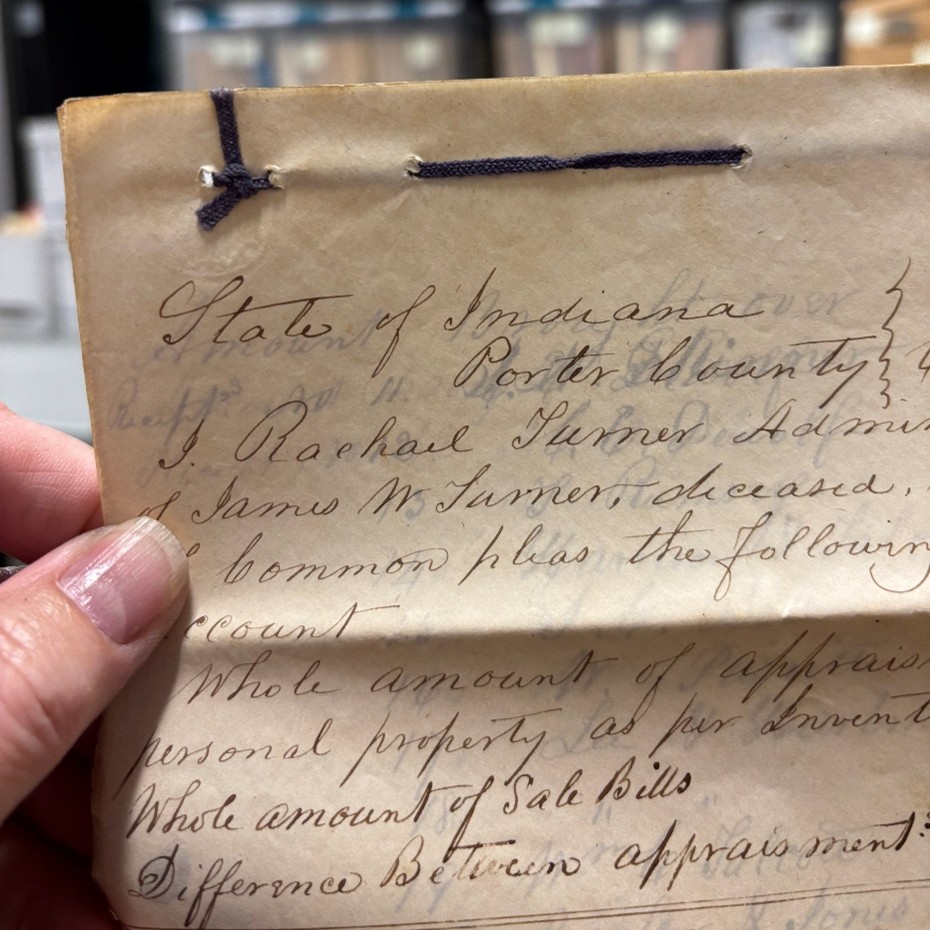
Early 19th-century attorneys, esquires, clerks and others who handled records commonly relied on ribbon, pins, thread, sealing wax and wafers to keep loose pages bound. Ribbon could be threaded through slits cut into a document, used to tie groups of papers, or combined with a wax seal.
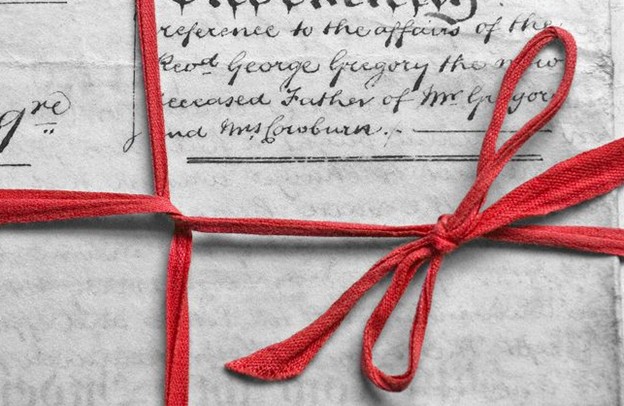
Official documents could even be sewn together with careful stitching. And the term “red tape” wasn’t originally a metaphor- we really had red tape!
The “red tape” was usually narrow cotton or linen ribbon. The clerk archives staff has processed many records that have been bundled together in this manner. It is no doubt that the “red tape” certainly helped to keep those old records organized back in the day. The phrase “cutting through red tape” has a very literal historical connection to the handling of court records. Over time, the red ribbons have faded to a spotty pink but the essence of their purpose still exists.
Straight Pins, Sealing Wax and Wafers
These weren’t originally an office supply. Straight pins were already widely used for clothing and sewing, but clerks and attorney’s staffers discovered that they could pierce several sheets of paper to hold them together. By the late 19th century, specialized “bank pins” were being sold for clerical use. Some later versions were even bent into a T-shape.
However, the downside soon became obvious- the pin damaged the paper.
A document fastened repeatedly with a pin could develop holes and eventually tear. That’s one reason the paper clip became so attractive—it could hold papers without puncturing them.
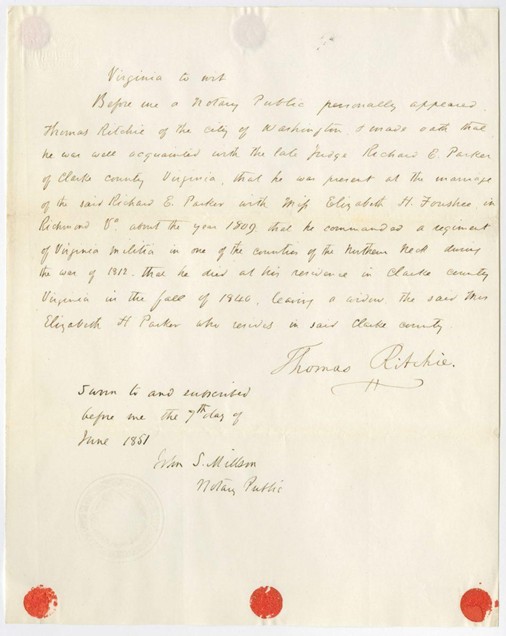
“Wafers” were small, thin adhesive discs made from starch, binders and pigments. They were commonly produced in the color red, along with an assortment of colors. They served as an early paper adhesive/seal, especially during the 17th through 19th centuries. At the Porter County Clerk Archives, we’ve encountered many documents that used this method of paper joinery.
“Sealing wax” was a much older technique and served purposes beyond simply holding papers together. It could authenticate a document, provide proof that it had not been opened and identify the person or office responsible for assembling it with an embossed crimp placed onto it.
Glue and Paste; Grommets and Eyelets
Glue wasn’t invented for offices in the 19th century—it had been used for centuries—but by the mid-19th century there is documentary evidence of papers being attached with mucilage/paste. Clerks and attorney offices desperately needed a way to manage growing mountains of paperwork, so they turned to liquid adhesives made from gum arabic or fish-based proteins to stick sheets together. While these sticky concoctions got the job done for quick attachments, they could be messy and didn’t always hold up to heavy handling.
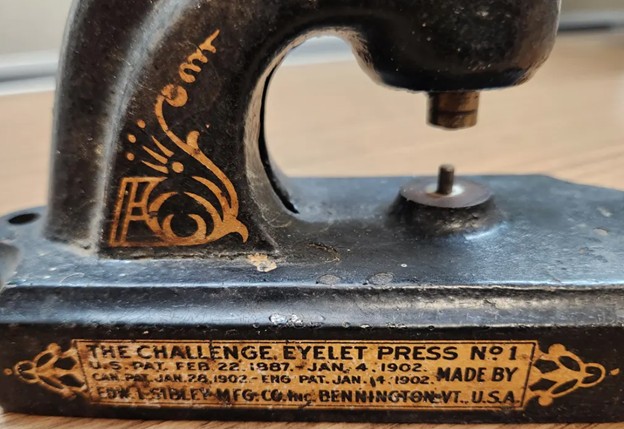
That’s why, by the mid-19th century, metal rings or eyelets were being used to reinforce holes through which documents could be fastened. If a worker needed to bind a thick legal file with ribbon or twine, these little metal grommets kept the paper from ripping apart at the seams. This clever mix of messy desktop pastes and early metal hardware became the ultimate tag-team, bridging the gap before modern staples and paperclips completely took over the office.
The drawback? A grommet generally required a special machine or tool to install it, making it less convenient than simply sticking a pin through a document.
Brass Fasteners — The Ancestor of Today’s Brad
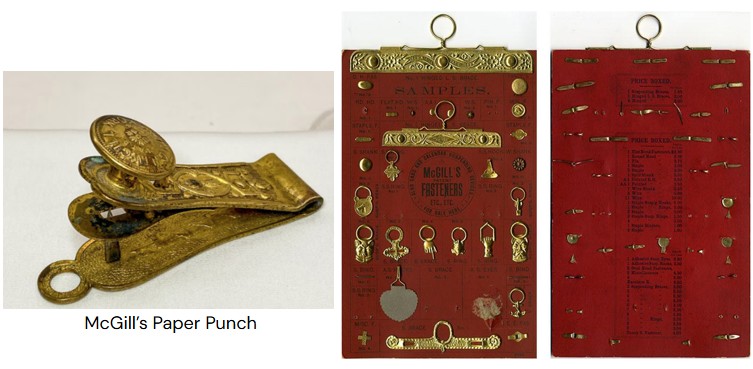
In 1866, George W. McGill patented a metallic paper fastener. His design used a strip of flexible metal with two legs that could be pushed through paper and bent outward to hold the sheets together. That is essentially the ancestor of the brass paper fastener (brad) we can still recognize today. McGill’s fastener was important because it provided the following features to the working public being it was:
- inexpensive
- reusable
- relatively strong
- easy to manufacture
- capable of holding considerably more paper than a straight pin
McGill went on to patent numerous improvements to paper fasteners. The Smithsonian’s Lemelson Center notes that he held more than 50 patents relating to the growing industry of fasteners.
Staples and Staplers
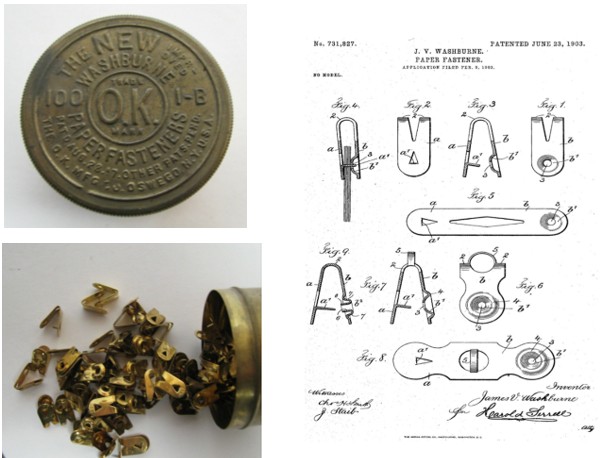
Paper Fasteners that were Pinched Over the Edges of Papers
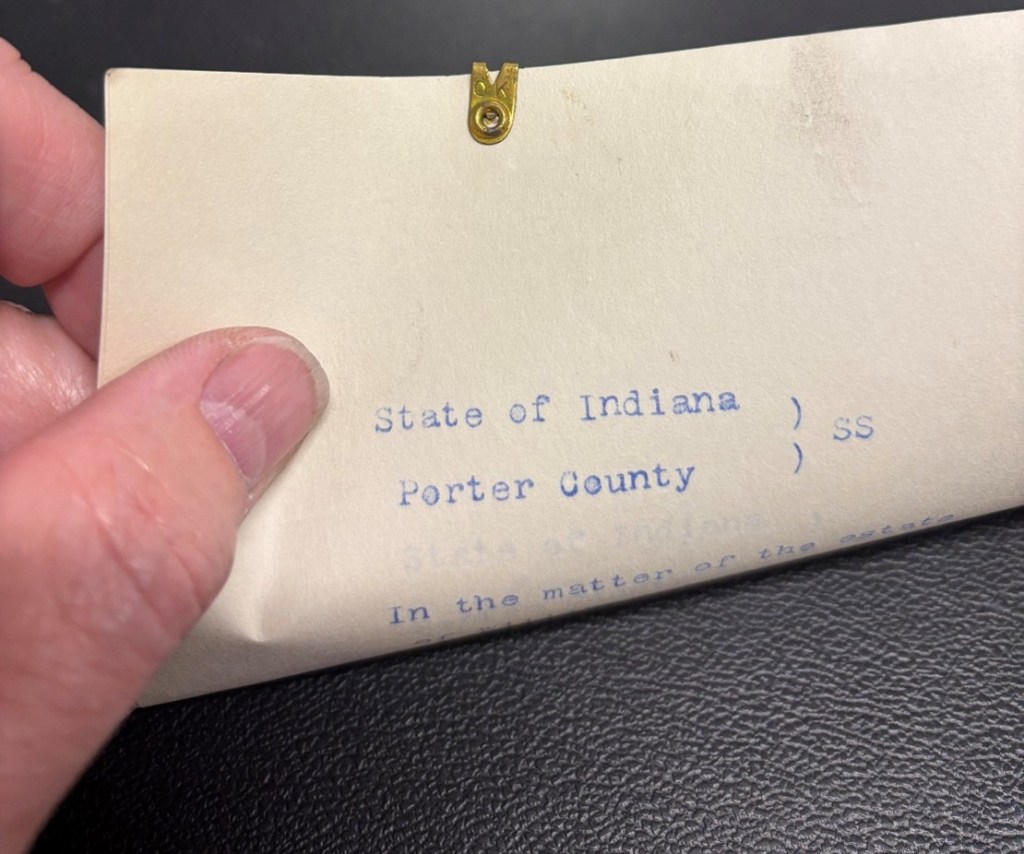
Metallic paper fasteners and machines for inserting them began appearing commercially in the late 1850s, with widespread advertising by the 1860s. McGill patented his bendable metal paper fastener in 1866 and a press for inserting it in 1867. By the 1870s, inventors were developing machines that could insert and bend the staple automatically. George McGill’s 1879 staple-fastener is generally considered one of the first commercially successful staplers. Another interesting detail, the word “stapler” didn’t appear in American published usage until about 1901, even though the technology was decades older.
Paper Clips
A U.S. patent for a bent-wire paper clip was issued to Samuel B. Fay in 1867. His clip was primarily designed for attaching tickets to fabric, but the patent specifically recognized its potential for fastening papers.
Erlman J. Wright was another inventor from Waltham, Massachusetts, who received a notable U.S. patent for an improved paper clip design on July 24, 1877. Under U.S. Patent No. 193,389, his improved paper clip was advertised at the time for holding together loose leaves, documents, periodicals, and newspapers.
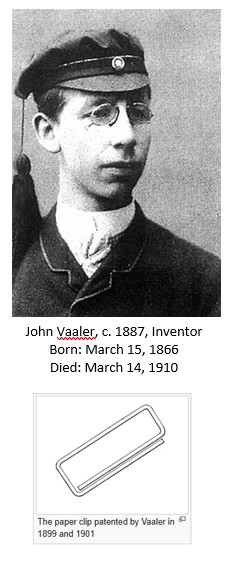
There’s been speculation on who was the actual first inventor of the paper clip. Johan Vaaler, a Norwegian inventor and patent clerk secured a patent in Germany and the United States for a paper clip consisting of a single thread wire in 1901. However, with the Gem double loop style being preferred by users, his patent was allowed to quietly expire in time.
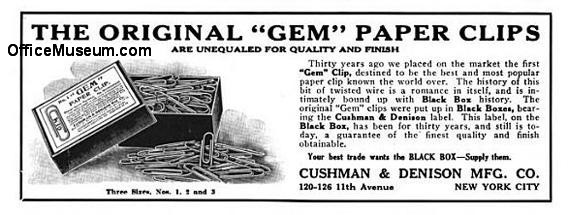
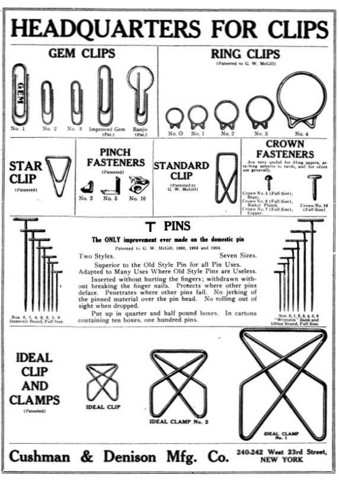
By the early 1900’s, the increasing popularity of the Gem-style paper clip became international. The Gem clip was being advertised by 1894, although it wasn’t patented. Cushman & Denison obtained the trademark “Gem” in 1904. The really important period is the late 1890s. By 1900, paper clips were becoming sufficiently common that one trade publication stated that wire clips had essentially superseded pins in modern offices. Aside from the dominant Gem, the “Ideal Paper Clip” (also known as the “Butterfly Clip or Clamp”) achieved the greatest commercial success. Launched by Cushman & Denison in 1902, its broad, bow-shaped wire design excelled at binding thick, bulky document stacks that the Gem could not handle. By successfully filling this utilitarian niche, the Ideal Clamp became an office staple and remains in mass production today.
Rubber bands, Adhesive Tape, Binder Clips
By the later 19th century, rubber bands were available for temporarily bundling papers.
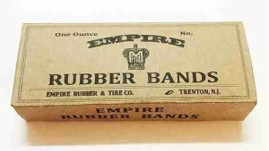
While indigenous peoples in Central and South America had used stabilized rubber for centuries, the modern office rubber band was patented on March 17, 1845, by British inventor Stephen Perry. Perry vulcanized rubber to give it elasticity and sliced it into thin loops. They were initially marketed primarily to hold bundles of papers, envelopes, and pharmacy pill bottles and became an essential product during World War II for military troops.
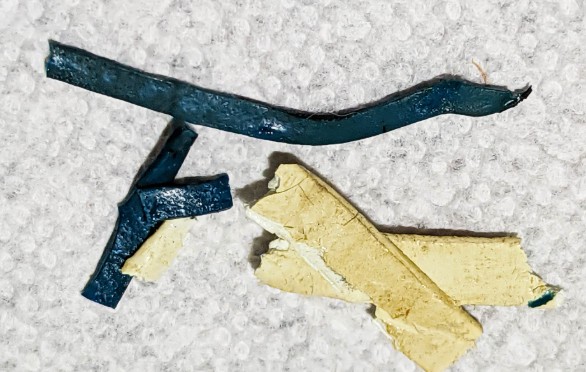
Unfortunately, when the archives staff comes across old rubber bands that once held documents together, they have turned black and brittle due to nearly a century of oxidation, ozone exposure, and continuous chemical cross-linking. This permanently stiffens and chars the polymer chains. This aging process is accelerated by the breakdown of 19th-century vulcanization additives, like sulfur and heavy metals, causing the rubber to dry out, darken, and snap. The blackened, broken pieces of rubber then chip off easily from the documents. Mistakenly, these chips often resembled mouse droppings in storage boxes! Hard to tell, but not impossible for the trained eye.
Adhesive tape became the next generation of office essentials. Pressure-sensitive adhesive technology actually dates back to 1845, when Dr. Horace Day developed a rubber-based adhesive tape for medical use. But it wasn’t until the 20th century that adhesive tape became an everyday office product. The major breakthrough came in the 1920s.
3M engineer Richard Drew developed masking tape for automobile painters, and 3M brought it to market in 1925. Drew subsequently developed cellulose tape, which appeared in 1930. That means the familiar transparent office tape has been in use for nearly 100 years! The adhesive tape can pose to be a problem for archival preservation though. Tape adhesives can discolor, become brittle and leave residue on historic paper. Modern archival methods are designed to hold papers together without damaging them. Removable tape is a less destructive method for record repairs.
Today’s modern binder clips have taken things to the next level of paper organizing, bringing it all together. A fastener isn’t just a piece of office hardware. It’s evidence. The original metal binder clip was invented in 1910 by Louis E. Baltzley of Washington, D.C., who officially received U.S. Patent No. 1,139,627 for his “Paper-binding clip” on May 18, 1915. His inspiration was close to home and created a wave of relief.
In 1909, keeping a thick document together was an absolute nightmare. Writers and lawyers who wanted to secure a bulky manuscript couldn’t just slide on a clip—they had to punch holes through the paper and literally sew the sheets together with string. If a typo sneaked onto page three, they had to slice the stitches open, swap the page, and start the whole tailoring job all over again.
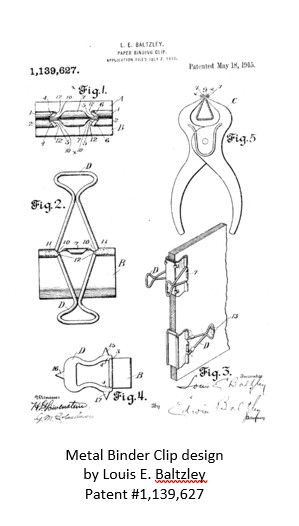
That was the exhausting reality for Edwin Baltzley Louis’s father. Edwin was a prolific writer who spent his days drowning in an unruly sea of loose notes and tangled thread. But his daily frustration sparked an industrial revolution at home. Watching his father wrestle with mountains of paper, Louis Baltzley stepped in with a brilliant stroke of family-first engineering. He bent a sheet of spring steel into a tight triangle, popped in two clever wire handles, and handed his dad the world’s very first binder clip. What began as a son’s simple act of love instantly rescued desks everywhere from the tyranny of the needle, transforming the way the world works forever.
When the Clerk Archives staff works with historical records, the little piece of metal, ribbon or thread holding a group of records together provides us with a clue about its age, year of creation or assembly, or volume of pages enclosed. These little gadgets are key indicators which help guide their daily tasks.
From a silk ribbon displayed on a record from the mid-1830’s to a rusty staple in a 1970s case file, the humble fastener had more ingenuity and sweat equity poured into it to create the perfect little device. What started as an invention of necessity, became a piece of history of its own. Next time you reach for that tiny metal clip, consider its unique journey and be thrilled it finally got here.

